Monthly Archives: September 2011

Idli – Steamed Rice Cakes

Idli is a breakfast food of south india. Very light and fluffy, easy to digest and very healthy – no oil involved and no frying – hurrah – it is steamed! It is the same fermented batter we saw for dosai – the combination of parboiled rice and dehusked black gram. It goes generally like this – idlis for breakfast, rice and curries for lunch and dosais for dinner. Idlis and dosais can be interchanged between breakfasts and dinners. Idlis are had with different kinds of chutneys (https://dosaikal.com/category/chutneys/) and sambars.

When one has a stomach upset, fever or the simplest ailment of all – laziness – if the batter is already made and stored in fridge – not to worry at all – quick and easy – soft and fluffy – idlis can take care of most of the simple health problems.

Idlis are usually never steamed beforehand and stored in hotcases. People get ready to go to the dining table – the women of the house start steaming idlis. It takes about 8 to 10 minutes to be ready. They go piping hot from the steaming mould to the breakfast or dinner plates or banana leaves. Immediately greased with ghee or gingelly oil as per preference and without delay soaked in sambar with a roll of the day’s chutney – are transferred straight into the tummy after some teeth work!

How much impatient a person might be, he would always be patient to wait for the steaming hot idlis. When thatha/grandfather is called to the breakfast table, he takes his plate, serves himself chutney and starts tapping the table like a tabla player, patiently waiting for not less than 5 minutes till idlis are ready to arrive on his plate.

When there are four or five members on the breakfast table or traditionally on the floor, each gets two idlis initially. By the time these are done, there might be a waiting time for quick eaters – till the next set arrives from the steamer. There is no problem waiting – what is most important is the piping hot soft texture of Idlis!

Truly, the lifetime of Idlis is too short. If we calculate from the time they are steamed to the time they go to the plate and within seconds they enter one’s food system – poor idlis… they live for a very little time – but deliver so well in such a short life span!

modern idli cooker


traditional idli kopparai


Idli/Steamed Rice Cakes

Ingredients

Idli Batter – as needed (https://dosaikal.com/tag/idli/dosa-batter/)

Method of Preparation

  1. Idli is made from a mould. The modern idli cooker generally has a stand with 4 layers or more – each plate makes 4 idlis
  2. The traditional idli maker is called Idli Kopparai – the idlis are comparatively bigger in size – the idli kopparai I have makes 13 idlis at a time – quite big ones
  3. Boil water in the steamer vessel 
  4. Grease the idli moulds with very little oil – this helps idlis to come out easily
  5. Mix the batter well and pour into mould till 3/4th to give space to rise well
  6. Steam in medium heat for 10 minutes
  7. To check whether idlis are done, prick either with a toothpick or knife – it should come out clean

 idli in mould


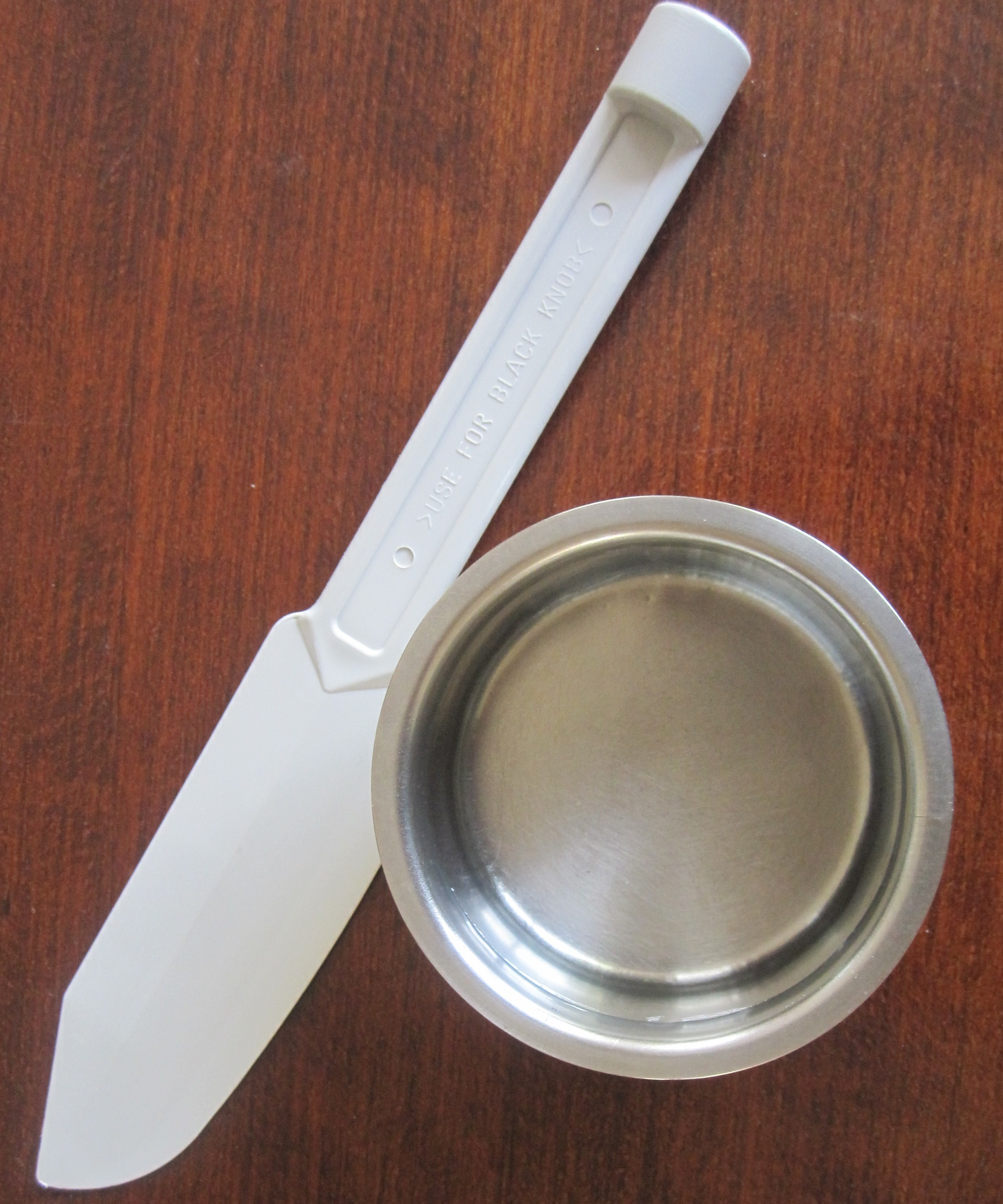
bowl with water and ladle


 To remove Idlis from mould

  1. Take a small bowl with water
  2. Easiest article to take idlis out is the plastic ladle of mixer grinder
  3. After the idlis are done, take the moulds out of the steamer and wait for 2 minutes
  4. Taking the idlis immediately out of the moulds might disfigure the idlis
  5. Dip the ladle in water and remove idlis
  6. Serve idlis with the day’s chutney (https://dosaikal.com/category/chutneys/), sambar or gun powder chutney.

steamed idlis

Basic Idli/Dosa Batter

Idlis and Dosais/Dosas are the most common and popular breakfast snacks of south india and especially tamilnadu. The soft and fluffy quality of Idlis or the crispy crunchy texture of Dosais – all depends on the perfect consistency of the batter. Par boiled rice and dehusked black lentils soaked, ground and left to ferment for a minimum of 6 hours or overnight – sounds like a tedious process! But having done this, there is no problem every breakfast or dinner time or even when we come back after a tired day’s work – the batter is handy for a quick breakfast or dinner or even inbetween hunger pranks!

The ground batter is used as Idli for the first day. The second day, when the batter becomes more sour is fit for making dosais. But I make dosais out of the first day batter too. The fenugreek seeds in the batter brings out the colour of the dosais.

parboiled rice


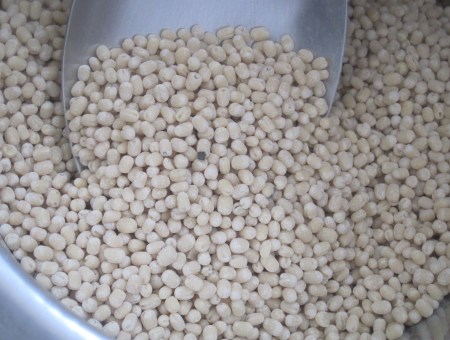
 dehusked black gram


 Basic Idli/Dosai/Dosa Batter

Ingredients (makes approximately 50 idlis or 40 dosais)

  • Parboiled Rice – 4 cups
  • Dehusked Black Gram (Urad Dhal) – 1 cup
  • Fenugreek Seeds – 1 tsp
  • Salt – 11/2 tsp

Method of Preparation of Batter

  1. Wash Urad Dhal and Rice separately until clean
  2. Soak the Black Gram (Urad Dal) and Parboiled Rice in water separately for minimum 6 hours or overnight
  3. Add the fenugreek seeds to the Urad Dhal before soaking
  4. First, grind the soaked Dhal and fenugreek seeds
  5. Use the soaked water for grinding to make a foamy batter – use only required water to make the batter foamy
  6. When it comes out foamy and soft, remove it in a big vessel
  7. Next, using the same soaked water, grind the rice until smooth
  8. Here too, use only required quantity of water for grinding
  9. Add salt to the big vessel and mix ground dhal and rice well with hand
  10. Cover and leave this batter for a minimum 12 hours so that it ferments well
  11. During colder temperatures, the batter can be kept in an oven at warm position overnight
  12. Generally if the batter is ground in the evening hours, it is fermented and ready to make dosais or idlis next morning during summers
  13. After each time of using the batter, it should be stored in the refrigerator

Stone wet grinder with batter


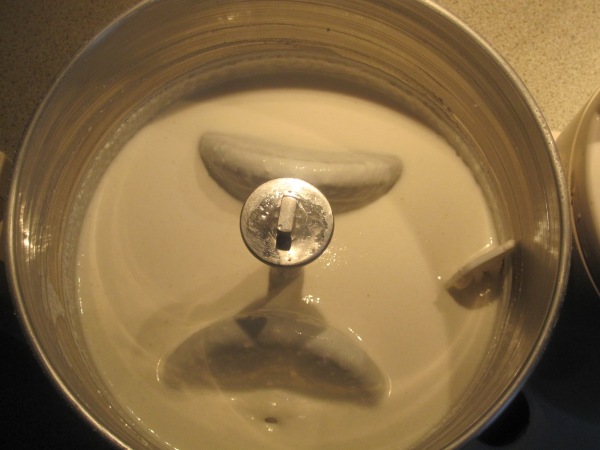
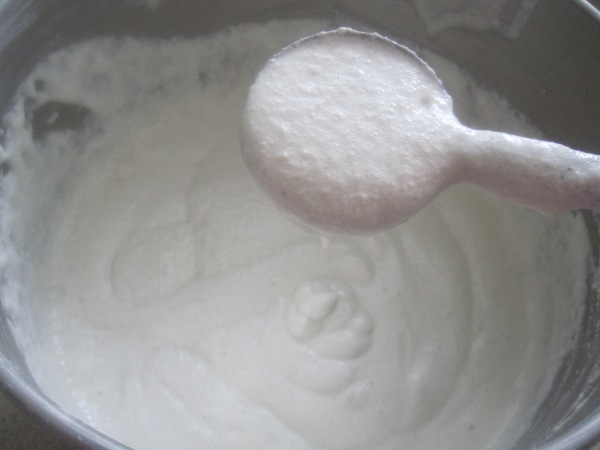
 well fermented foamy batter


Things to remember while preparing batter

  1. The quality of ground dhal makes all the difference – it should be foamy, silky and very soft
  2. Quality check – Dip your hand in water and immediately give a soft touch to the batter. If the batter doesn’t stick to your hand, it is ready and is right time to remove from grinder or blender
  3. Rice should be ground smooth without any granules
  4. Always mix salt to the ground dhal and rice with your hands. Body temperature helps in proper fermentation
  5. Make idlis or dosais only after batter is well fermented – it should rise well.

Storage of Dosai/Dosa Batter

  1. Once the batter is done and fermented, it should be stored in the refrigerator
  2. Each time idli or dosai is made, take the needed quantity in a separate vessel and keep the rest back in the fridge again
  3. Do not mix water to the whole batter to make the consistency better. Each time you take out the required quantity of batter, adjust water accordingly
  4. While making batter in more quantities, after it is fermented and ready, mix it well from the bottom of the vessel, transfer it to two separate bowls
  5. The bowl with the top part of the batter should be used later
  6. The bowl with the bottom part of the batter should be used first as it may contain more of the rice paste settled at the bottom and it may make the batter thicken and sour faster
  7. Once the first bowl is over, even after a couple of days, the second bowl is fresh enough to make fresh idlis like the first day batter
  8. This is how my mother and grandmother uses the batter made from huge wet grinders.

Modhakam – pillayar chaturthi special

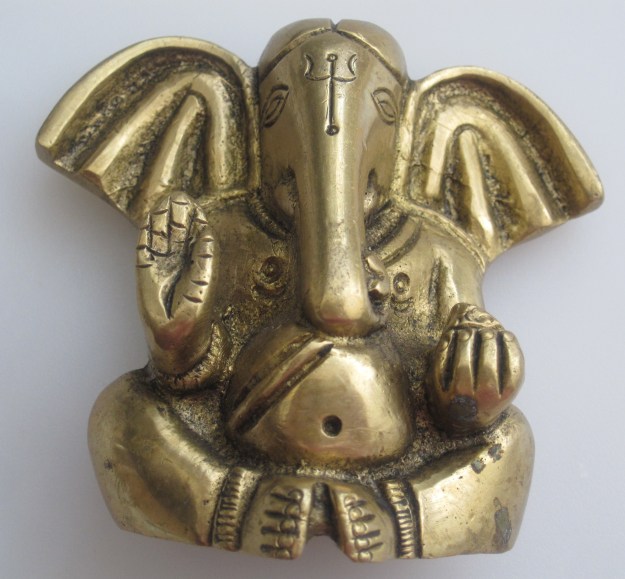
The celebration of Ganesh Chaturthi or the birthday of the Hindu deity Ganesha is associated more with the state of Maharashtra in India. It is believed that Lord Ganapati was the family deity of the Peshwas. After the end of Peshwa rule, Ganesh Chaturthi remained a family affair in Maharashtra from the period of 1818 to 1892.

In 1893, Indian freedom fighter and social reformer Lokmanya Tilak transformed the annual domestic festival into a large, well-organized public event. (http://en.wikipedia.org/wiki/Ganesh Chaturthi).  

Lord Murugan is the God of the Tamils. He is referred to as ‘Tamil Kadavul’. Archaeological findings of pottery and relics in several places in Tamilnadu, particularly in Adichanallur, had ideographic inscriptions of this name and show signs that Murugan worship was prevalent at least as early as 10th century B.C, if not earlier.

Lord Murugan is also associated with Ahmuvan, an Indus Valley Deity.

According to noted epigraphist Iravatham Mahadevan, the ideographs signify a brave warrior capable of killing evil beings to save the devoted. (http://en.wikipedia.org/wiki/Murugan).

So, when did ganesha/vinayakar or pillayar worship come to Tamilnadu? There are many versions that lead us to historical references.

1. It is popularly said that ganesha was brought into Tamilnadu after the Vatapi War.  

Narasimhavarman I was a Tamil king of the Pallava dynasty who ruled South India from 630–668 CE. He avenged his father’s defeat at the hands of the Chalukya king, Pulakesi II in the year 642 CE.

 Pulakesi II, a renowned early Chalukya king, had previously raided various northern Pallava provinces and forts. However, he was unable to capture the Pallava capital of Kanchipuram. This led to a long conflict between the Chalukyas and the Pallavas.

Narasimhavarman defeated the Chalukyas in several battles, including one at Manimangalam 20 miles to the east of Kanchipuram. Encouraged by this victory, Narasimhavarman led his army along with his general Paranjothi and invaded Vatapi (Vatapi was the name of Badami the chalukya capital situated in present day Karnataka) successfully defeating the Chalukya king Pulakesi II in 642 CE. He returned victorious to Kanchipuram, and was given the title Vatapikondan (one who destroyed Vatapi).

His general Paranjothi was known very well for his devotion to Lord Siva and as one of the 63 Nayanmar saints, is said to have indeed personally destroyed the city of Vatapi under the command of Narasimhavarman I. He is also known as ‘Siruthonttar’. (http://en.wikipedia.org./wiki/NarasimhavarmanI)

It is generally assumed that Ganesha was brought to Tamilnadu by Siruththondar. After the victory over Chalukyas in Vatapi, he brought back a statue of Vinayaka. This statue, he placed in the Siva temple of his home town – Thiruchenggattangudi. In Thiruchengattangudi, even today the vinayakar is called Vatapi Ganapathi.

2. Whether the Thiruchengattangudi Vatapi Vinayakar was the first to have come to Tamilnadu is still controversial. The rock-cut Ganesha- the Karpaga Vinaayagar of Pillaiyaarpatti fame is earlier than the period of Siruththondar. (www.visvacomplex.com/GanesaWorshipInTamilNadu

3. Beyond these facts, there is another instance where the name Ganapati is referred to in literature – in Appar Thevaram.

Among the 63 Nayanmar’s of Saiva Bhakti literature, Appar or Thirunaavukkarasar holds a special place. A Saivite by birth, he embraced Jainism in his early years. Later, after the intervention of his sister Thilakavathiyar, Lord Siva made him realise Saivism and he became an ardent devotee of Lord Shiva.

The Jain leaders did not like the return of Thirunaavukkarasar to Saivism. They approached the then Jain King Mahendra Varma Pallavan to punish him. Appar antagonised the Jains and the Pallava emperor, Mahendra Varman I. The king tried in many ways to punish and kill appar.

After some failed attempts, the king ordered to tramp Thirunaavukkarasar by the Royal elephant. Thirunaavukkarasar with heart filled with devotion for Siva,  sat down and sang the hymn which starts –  

Sunna ven sandhana chchaandhum sudar thingat chuulaa maniyum….

and ends –
Anjuvadhu yaadhondrum illai anja varuvadhum illai

(we are not afraid of anything. There is nothing that can frighten us.)

The elephant instead of tramping on him saluted him with its trunk. In one of these hymns, appar mentions

‘kalamalak kittuth thiriyun ganapathi yennun kalirum’

Here, there is a mention of Ganapati.

This ‘anjuvadhu yadhonrum illai’ hymn predates Siruththondar’s invasion of Vatapi by at least 30 years. (www.visvacomplex.com/GanesaWorshipInTamilNadu). For more details on thevaram and nayanmar saints visit www.shaivam.org./tamil/thiru04.html. This website gives the hymns of all nayanmar saints in detail.

Appar sang these hymns in front of King Mahendra Varman, the father of Narasimhavarman – under whom Siruthondar brought Vatapi Ganapathi to Thiruchengattangudi. King Mahendra Varman too returned back to Saivism.

4. The rock-cut Pillaiyaar of Mahipaalanpatti is also very ancient and is quite unique. There is no other statue like it, in Tamilnadu. Mahipaalanpatti is known by the name Poongunram in Sangam ages. This was the home-town of kaniyan poongunranaar – one of the great poets of sangam literature. (www.visvacomplex.com/GanesaWorshipInTamilNadu).

I could not find more details about the Pillayar in Mahippalanpatti in the net. There are only geographic references to the place and not the temple.

Now, back to cooking! Ganesh Chaturthi or Pillayar Chaturthi – birthday of Lord Ganesha fell on 1st of September this year. It is a late post on that issue – but better late than never!
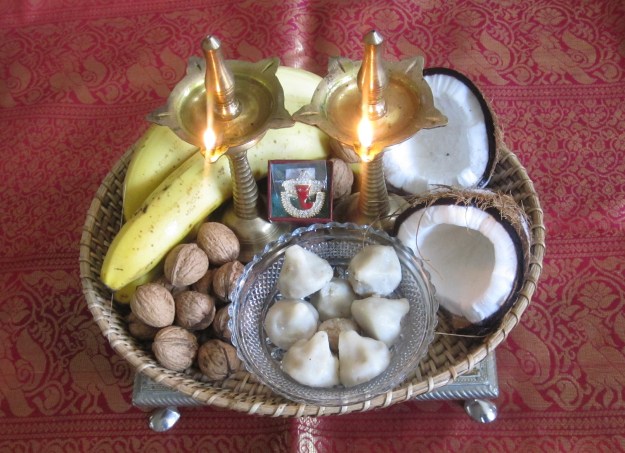
Pillayar Chaturthi or Ganesh Chaturthi is marked by modhakam – coconut jaggery filled dumplings – lord ganesha’s favourite. Waking up early and making 108 modhakams used to be the duty of children guided by amma. The exotic smell of roasted coconut mixed with jaggery would wake us up. After a quick hair wash, no solid food before puja – only coffee, tea or milk, we would start making modhakams.

When 108 is done and everything else ready for puja – more than ganesha, our tummies would be longing for the steamed white modhakams. Ofcourse, after distribution of modhakams in the neighbourhood, the whole day is there to finish the wonderful, jaggery syrup flowing sweet balls!
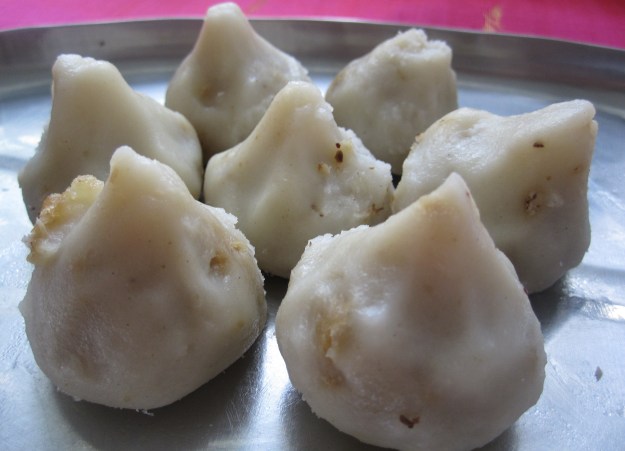
 

Modhakam (approximately 20 dumplings)

Ingredients

For the filling

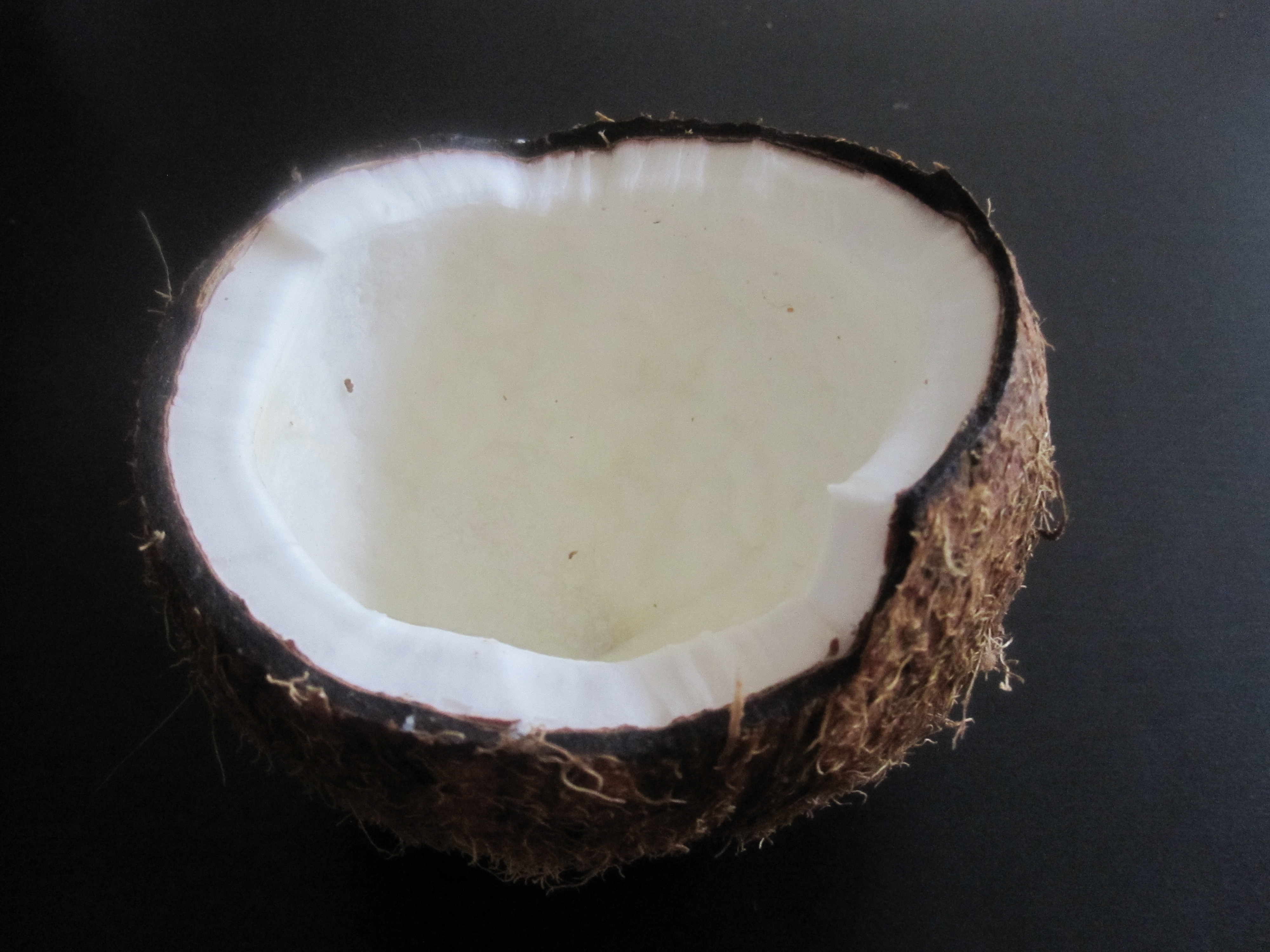
  • coconut – one half portion
  • grated jaggery – 1/2 cup
  • dry ginger powder – 1/2 tsp
  • cardamom powder – 1/2 tsp

For the flour dough

  • rice flour – 200gms
  • hot water – 200ml
  • gingelly oil – 2 tsp

Method of Preparation

Filling

  1. Take grated coconut in a kadai and roast it slightly
  2. Coconut need not be roasted till golden brown
  3. In a pan, melt jaggery with 1/4 cup water
  4. Wait till jaggery melts and the mixture bubbles up
  5. Bubbling up of jaggery and water is the right consistency to be added to roasted coconut
  6. Strain the jaggery syrup to coconut and fry till coconut absorbs most of the water
  7. Add dry ginger powder and cardamom powder
  8. Be careful not to thicken the filling too much as jaggery would tighten further more after it is cooled
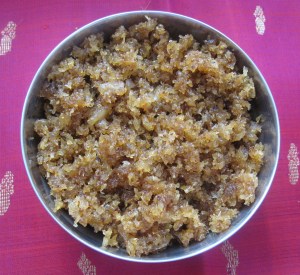
  9. For the right consistency – press the mixture with a ladle – there should be a little thick syrup which oozes out
  10. Filling is ready

roasting coconut

coconut jaggery filling
Dough for dumplings

  1. Boil water in a vessel
  2. Add 2 tsp of oil to water
  3. In a bowl, take rice flour and pour boiled water on it
  4. Mix it well initially with a ladle and then make it smooth with hand
  5. Dough is ready

Preparation of Modhakam

  1. Grease your palm with very little oil
  2. Take enough dough to make a small ball
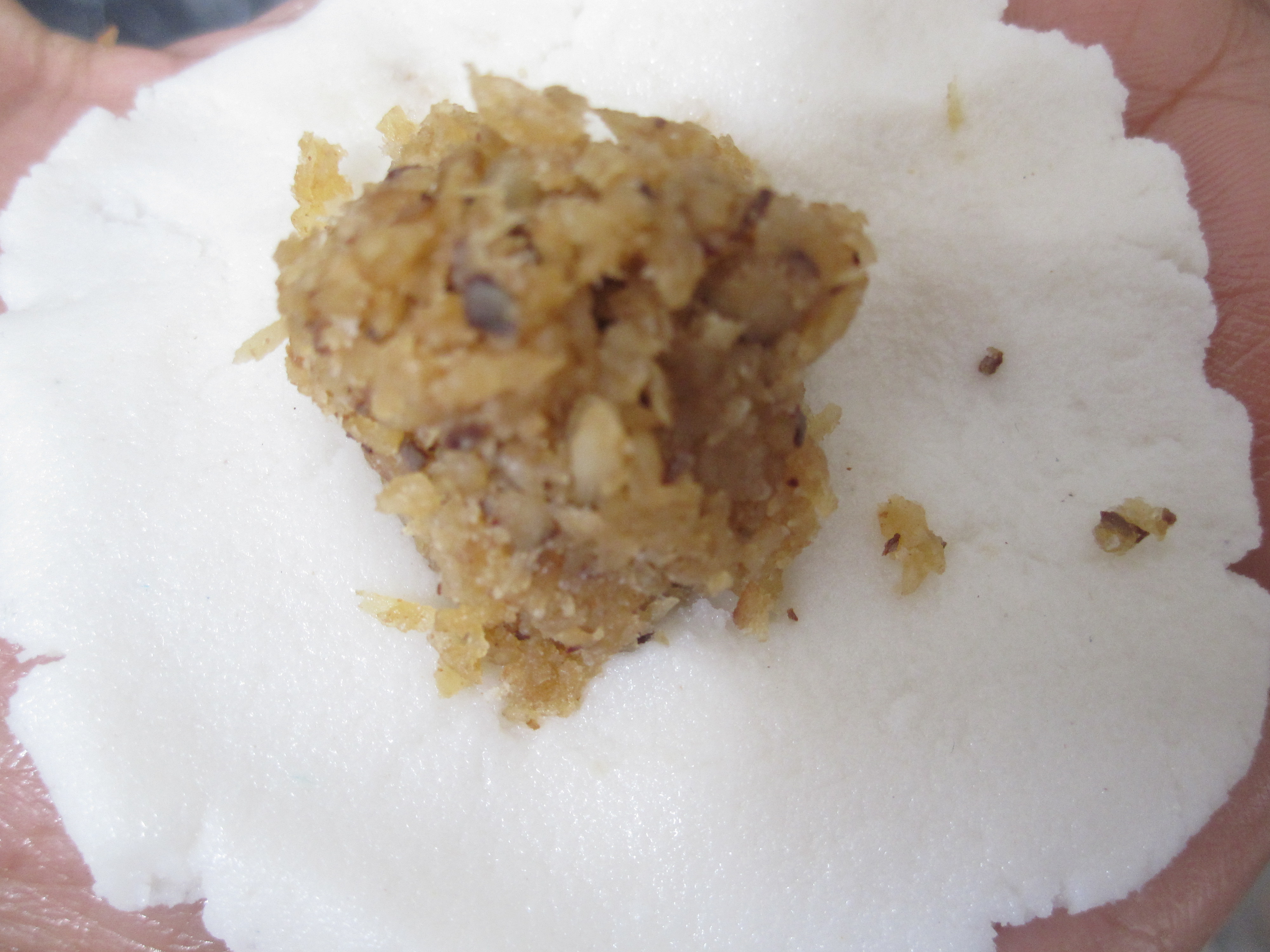
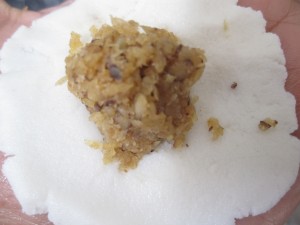
  3. Flatten the ball and spread it on the palm
  4. Keep a tsp or just enough filling (easy enough to close the dumpling without the filling peeping out)
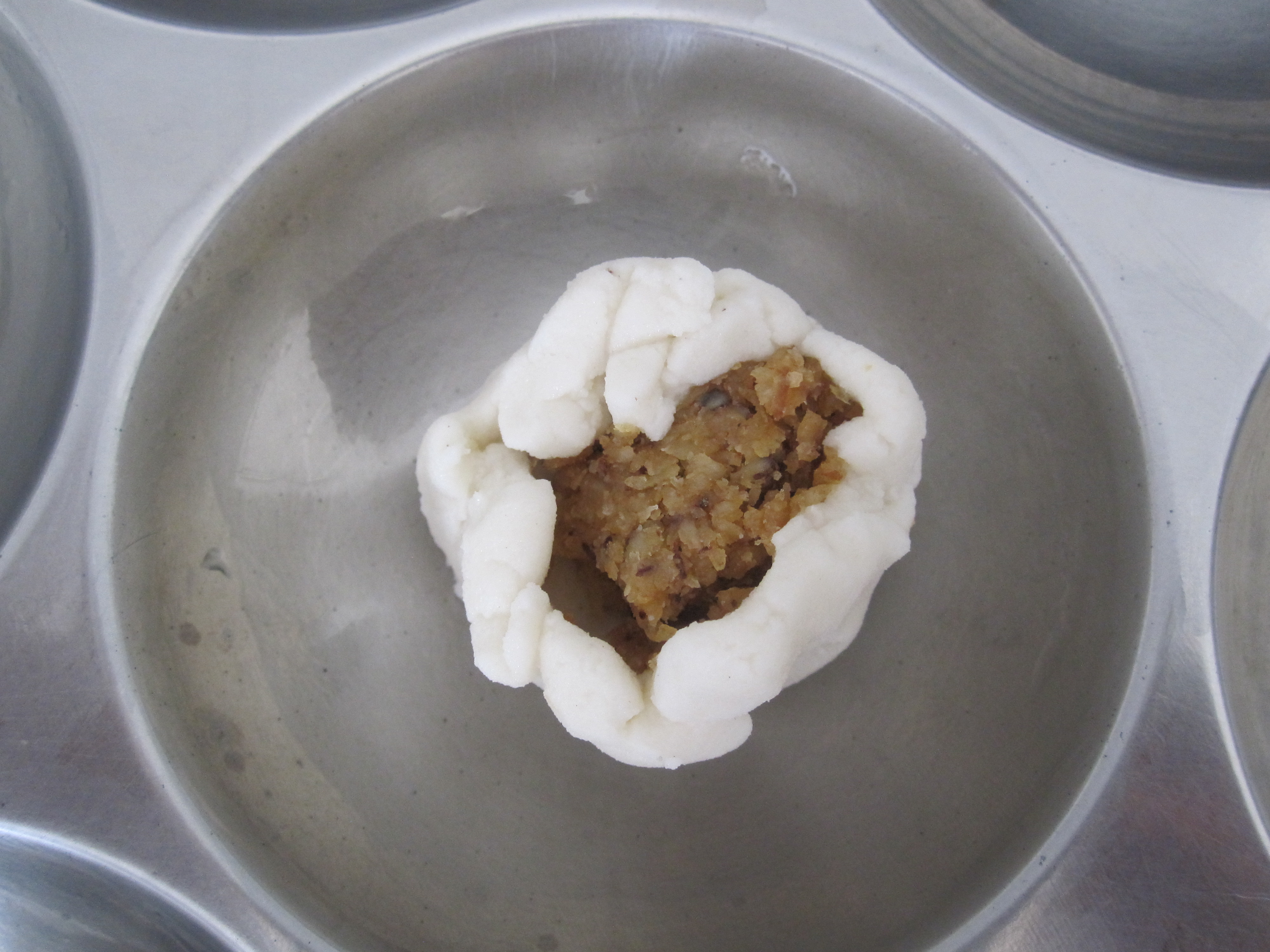
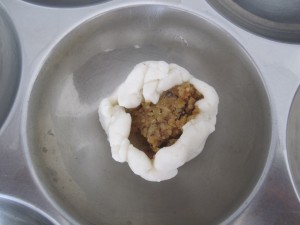
  5. Close it (see picture)
  6. Either leave it as a ball or make a sharp tip (picture)
  7. Shape can be as per one’s preference (we even used to make ganesha’s ears by folding the dough in the shape of ‘D’)

spread dough on palm and place filling
close the dumpling
 press and close the tip for a better shape
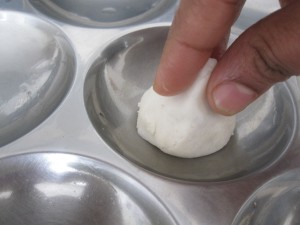
 nearly perfect
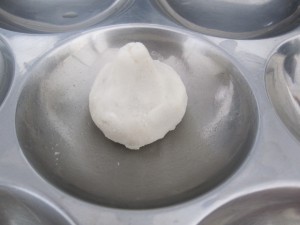
 

Steaming Modhakams

  1. Take an Idli Kopparai/Idli Cooker or any Steamer
  2. Boil water till the required level
  3. Oil the moulds and place the dumplings/modhakams
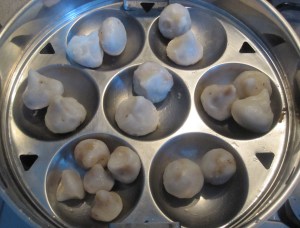
  4. Place the mould in the steamer and steam for 15 minutes

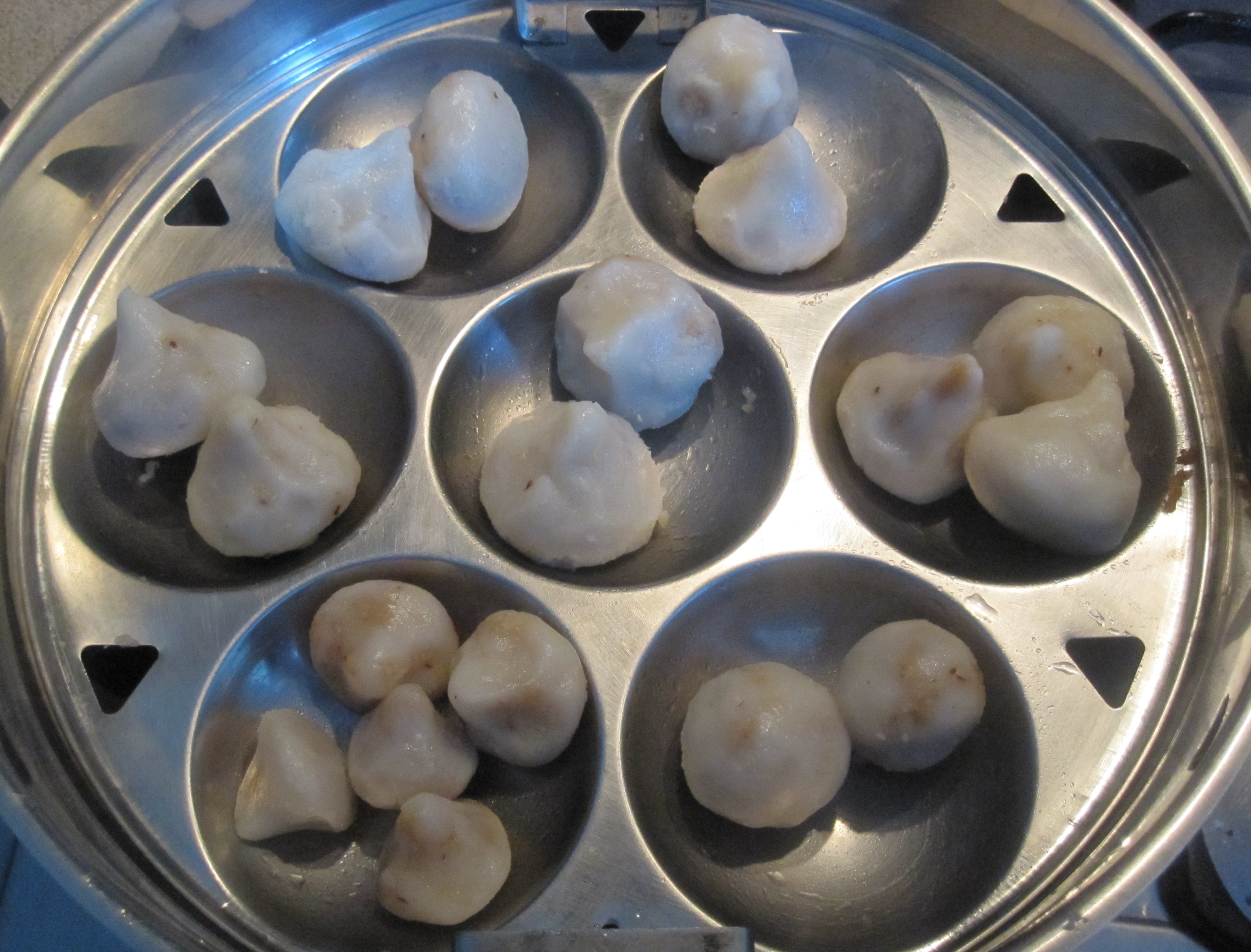
modhakams in rice kopparai
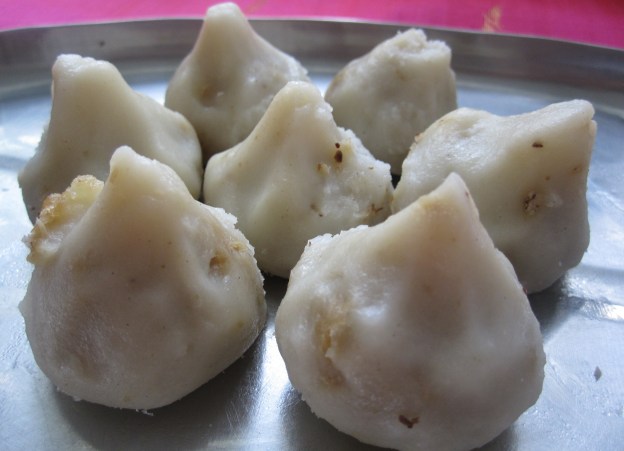
steamed modhakam
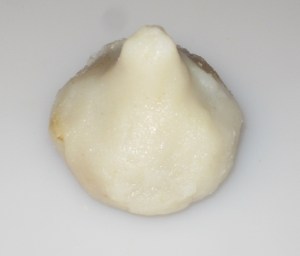
Modhakams are ready to be served!

Adai Pradhaman/ Ada Pradhaman

I have always felt jaggery based sweets are more traditional… might be because special occasions are marked by those made of jaggery. Pongal is celebrated with sarkkarai pongal which is sweetened by jaggery. Diwali though not a traditional tamil festival, is marked by adhirasam which is again made of jaggery. Or more so because, in today’s world everyone prefers making the comparatively easier sugar based sweets to the time-consuming  jaggery based sweets.

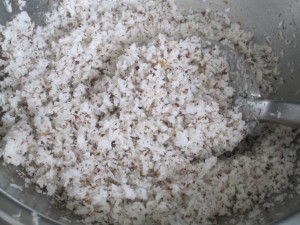
Adai pradhaman is one such sweet. Though it is more popular as a kerala payasam or kheer, the people of tirunelveli district of tamilnadu, having proximity geographically to kerala also prepare this payasam. When we were young, adai – flakes of cooked rice – the base of this payasam was not available in shops in chennai. My grandmother used to send from tirunelveli where it was made in bulk. In kerala, it is made fresh for the payasam.  Nowadays it is very easily available in packets in most of the indian shops even if we live abroad.

Till today, I believe adai pradhaman is the most heavenly and divinely of all payasams! The smell of adai or flakes of cooked rice, cooked in jaggery, and coconut milk added slowly would travel around the house… not to leave the cashewnuts fried in ghee poured on top of it.  Another payasam to come close to this would be paasi paruppu payasam/ dehusked green gram (moong dhal) payasam (recipe shortly).

Unlike Kerala where adai pradhaman is a festival sweet, in tamilnadu or more specifically tirunelveli, it is prepared for guests and special occasions. Sometimes it used to be a sunday special and I used to be so delighted to have tirunelveli special in chennai! Now to the recipe..

This recipe needs thin – 3rd milk, medium thick – 2nd milk and creamy thick – 1st milk of coconut to be added gradually in the rice flakes cooked in jaggery. Here, I have minimised work by using canned coconut milk.


Adai Pradhaman

Ingredients

  • adai/flakes of cooked rice – 200 gms
  • vellam/jaggery – 400 gms
  • coconut milk – 1 can – 200 gms
  • ghee – 2 tbsp
  • cashewnuts – 12 no. halved
  • cardamom powder – 1/2 tsp
  • dry ginger powder – 1/2 tsp

the humble Nut


palm jaggery might give a darker colour to the payasam


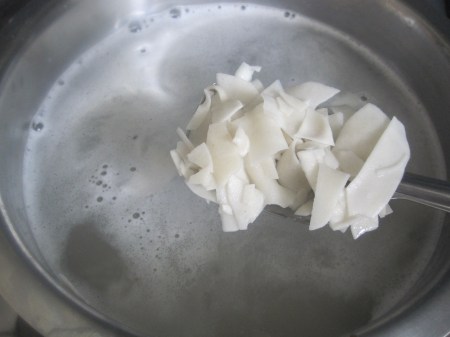
cooking adai


jaggery might have impurities


 Method of Preparation

  1. Boil water in a big utensil
  2. Always add adai to boiling water as these  flakes might stick to the bottom of the utensil if water is cold
  3. Adai should be completely immersed in water and there should be enough water to cook the adai 
  4. When it is cooked soft, drain and wash in cold water 
  5. In a separate pan, take jaggery and 1 cup of water
  6. When jaggery is melted, filter it
  7. Cook adai in filtered jaggery in a hard bottomed wide cooking pan
  8. After about seven minutes add half the canned coconut milk
  9. Simmer for five minutes. If the payasam tends to thicken, little water can be added to adjust the consistency. This thickening might be due to the thick canned milk. Mostly this doesn’t happen when thin and medium thick 3rd or 2nd milk is gradually added
  10. Add cardamom powder and dry ginger powder and mix well
  11. Now add the remaining coconut milk and let it cook for another five minutes
  12. Payasam is done. Turn off the stove
  13. Fry cashewnuts till golden brown in ghee and pour it on the adai pradhaman
  14. Tastes best when served on a banana leaf. Tackle it with all five fingers and palm to send it to the taste buds of the tongue.  


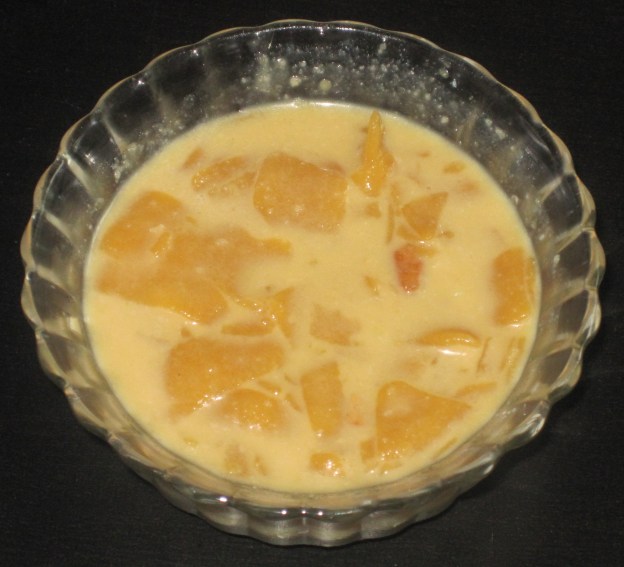
Adai Pradhaman