Author Archives: dosaikal

Unknown's avatar

About dosaikal

A simple person who believes strong roots and values build up stronger generations; and good food and good food habits are one of the best gifts that one can give to their off springs.

Butter and Egg Wheat Cake


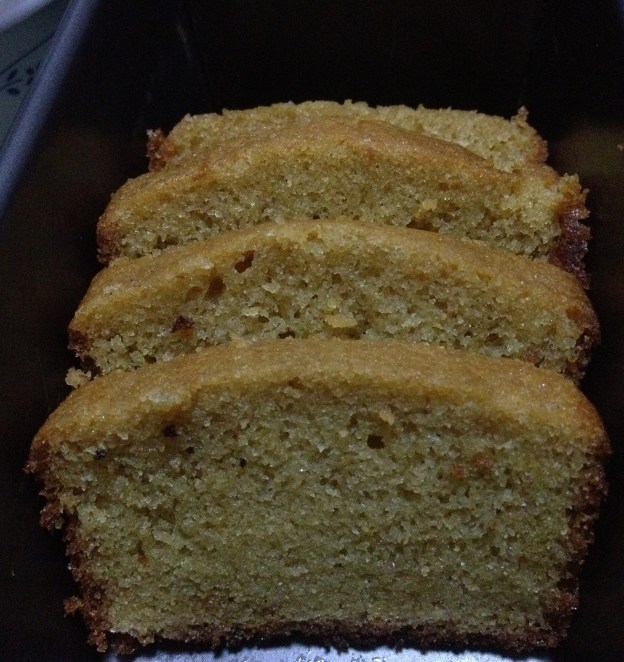
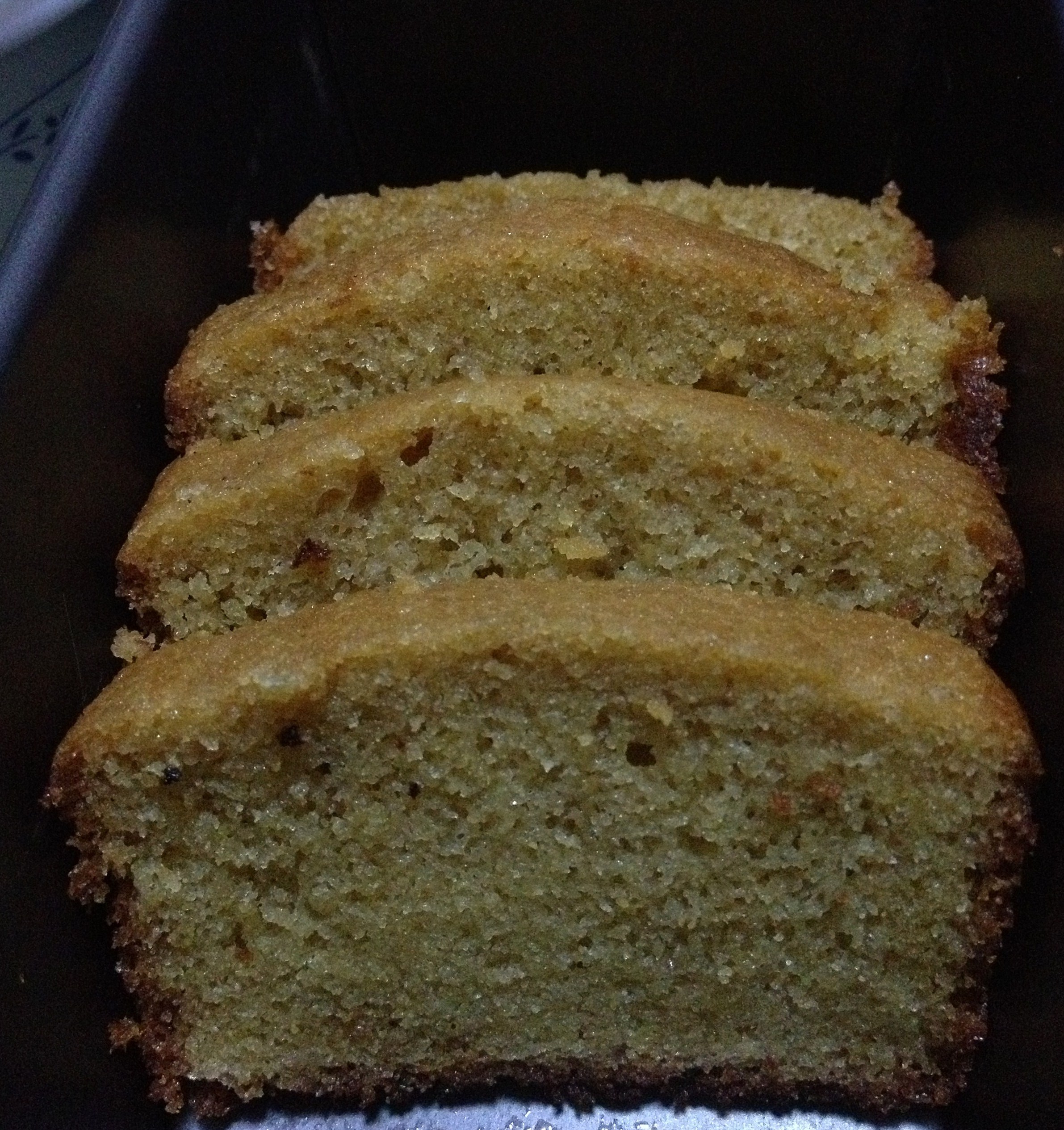
Ms. Vanitha asked for the Basic Wheat Cake (https://dosaikal.com/basic-wheat-cake) with butter and eggs instead of oil and omission of eggs. So, I tried the cake this weekend. It came out really well, not to mention the guilt of having butter in the cake. My daughter was very happy to beat the eggs and I went back to my younger days when I used to blend butter and sugar for amma. Truly a lick of butter and sugar beaten together is a joy forever….So, I decided to indulge the previous weekend!

The cake came out very good – soft but intact; with the flavour of butter and eggs and perfectly moist.

Butter and Egg Wheat Cake

IMG_1926


Ingredients

  • wheat flour – 100 gms
  • sugar (I used brown cane sugar) – 75 gms
  • butter– 100 gms
  • egg – 2 nos.
  • yoghurt/curds – 3 tblsp
  • water – 3 tblsp
  • baking powder – 1/2 tsp
  • baking soda – 1/2 tsp
  • vanilla extract – 1 tsp


Method of Preparation

  1. In a wide bowl, beat butter and sugar – enough to melt sugar
  2. Whisk eggs separately and add to the blended butter and sugar
  3. Powdered sugar can also be used for easier melting
  4. Add vanilla extract and mix
  5. Mix baking soda and baking powder with gothumai maavu/wheat flour/atta
  6. Start adding flour little by little to egg, sugar, butter mixture
  7. When the batter has become a bit thick, add yoghurt to set right the consistency
  8. Add all the flour and if needed add water to bring batter to thinner consistency
  9. The yoghurt I used was full cream yoghurt. So I added water to the batter to make it thinner.
  10. Grease a baking pan and dust it with a light coating of flour
  11. Pour the batter into the pan
  12. Preheat oven at 200 degrees centigrade and bake for 25 minutes
  13. Check at 20 minutes with a tooth pick – if it comes out clean, cake is ready
  14. Baking time might vary, depending upon the oven. So, it is better to check at 20 minutes
  15. Remove from oven and let it cool to serve.

Entering Year 3! Paasi Paruppu Payasam/Dehusked Green Gram Pudding/Kheer


paasi paruppu payasam

IMG_1297


The second year of blogging has not been a continuous writing affair… though there was no end to cooking affair! Too much into packing, shifting places, entering new places and faces, unpacking and settling has been quite tedious. When I look back, the previous year has been a slow-paced one… sometimes out of sight for a couple of months too. But I feel overwhelmed by the support I have received in spite of those long intervals.

NANRI – Thanks a ton – for understanding my absence for short periods!

During this period of settling down, the new subscribers that joined hands with me and my old friends who have been continuously keeping pace with my posts, have made me feel more guilty of not having settled sooner and not having posted more. I shall surely try to compensate on that this year.

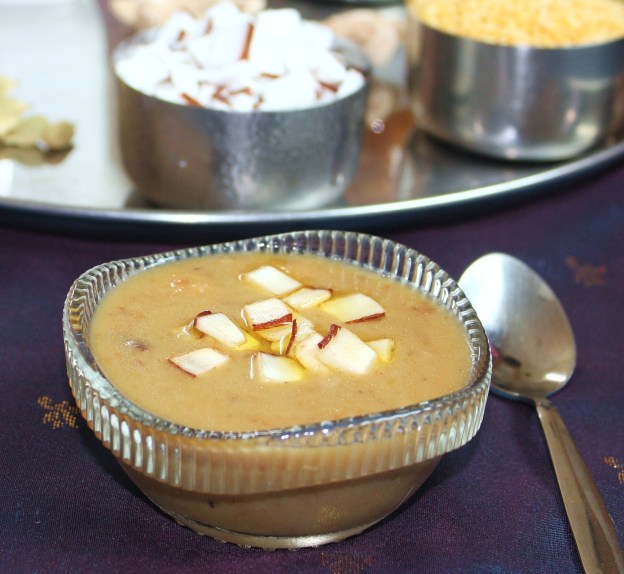
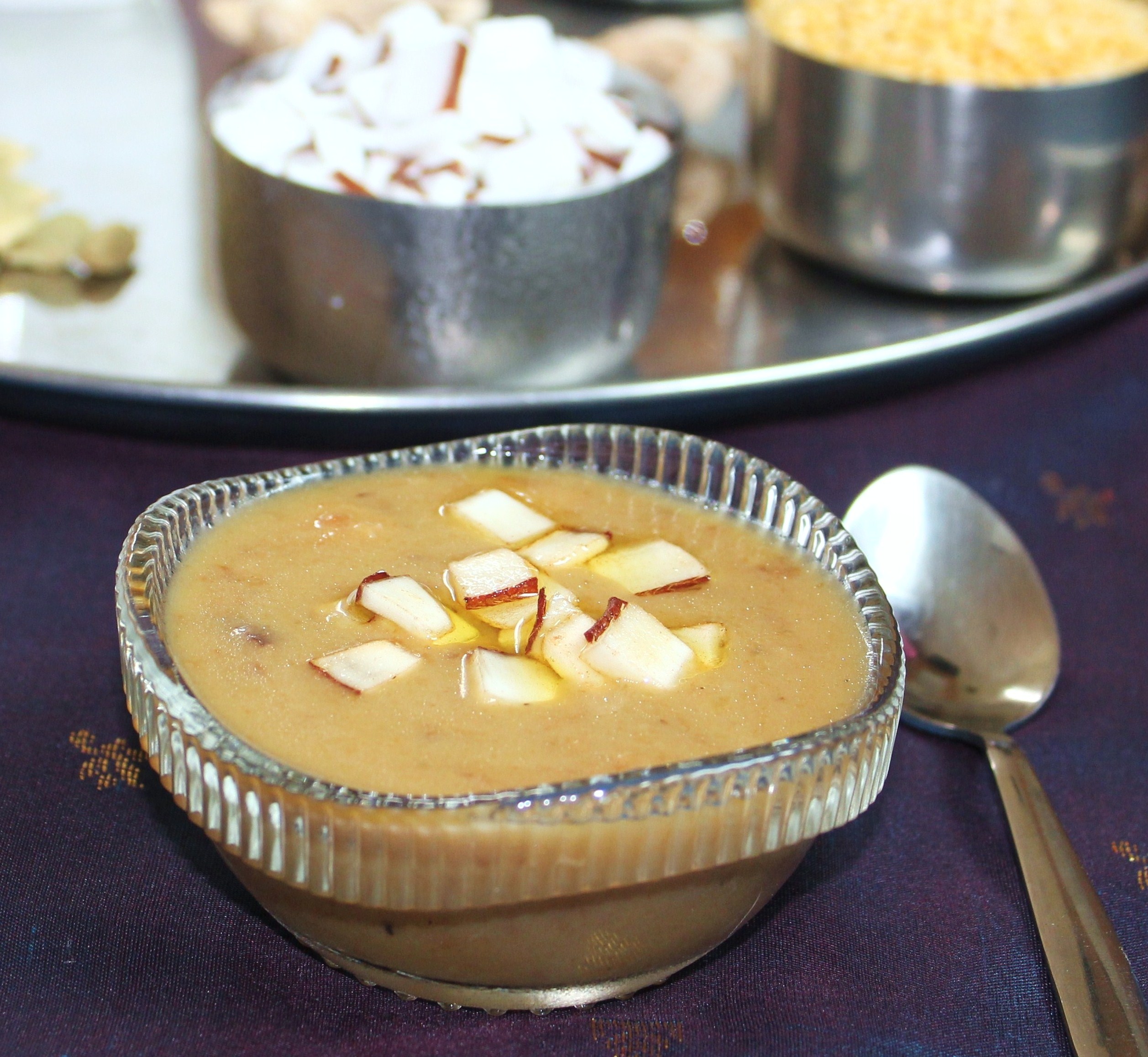
As usual, let’s enter another year with a sweet dish. This is one of my favourite payasams, of course next to Adai Pradhaman (https://dosaikal.com/adai-pradhaman-ada-pradhaman).J aggery and coconut milk make a sweet dish heavenly! This is one such payasam/pudding/kheer, with dehusked green gram. Generally, in payasams or any sweet dish, nuts are roasted or fried in nei/ghee to add richness and flavour. Here, traditionally, thinly cubed coconut pieces are fried in nei/clarified butter and added to the completed payasam. The coconut pieces can be added with fried cashewnuts. But, they can taste good all alone without the nuts too! Here, I have avoided the nuts and added fried coconut pieces alone.

I have seen aachi and amma always use chukku podi – dry ginger powder when jaggery is used in sweets. Adding dry ginger to jaggery helps in avoiding acidity and gastric problems. When the dish has coconut milk to make it a heavy intake, chukku podi/dry ginger powder would aid in easy digestion too!
 

Paasi Paruppu Payasam


IMG_1316
 

Ingredients (serves 4-6)

  • paasi paruppu/dehusked green gram – 3/4  cup
  • vellam/jaggery – 1/2 cup
  • water – 1/4 cup to dissolve jaggery
  • thengai pal/coconut milk – 1 and 1/2 cup
  • chukku podi/dry ginger powder – 1/2 tsp
  • elakkai podi/cardamom powder – 1//2 tsp
  • thinly cubed coconut pieces – 3 tblsp or lesser as per preference
  • nei/clarified butter – 2 tblsp


Method of Preparation

  1. In a pan, roast dehusked green gram till golden brown, no oil or butter needed
  2. In the same pan, fry coconut pieces in clarified butter till golden brown
  3. Cook the gram in pressure cooker with enough water till done; do not overcook
  4. While the green gram is getting cooked in the pressure cooker, dissolve jaggery in just enough water (1/4 cup). Strain it to avoid impurities
  5. Now on, the preparation is really easy and simple – Strain jaggery into the pressure cooker with cooked lentil
  6. Add dry ginger powder and cardamom powder and bring the mixture to a slightly thick consistency; if the cooked lentil is already thick and with very less water and the addition of jaggery has made it thicker, not to worry – add very little water if needed. This might help blending jaggery well with the lentil
  7. When jaggery is well blended with cooked lentil, add coconut milk. I used canned coconut milk
  8. If the payasam is too thick in consistency, add 1/2 cup water to dilute it.  If one likes the thicker version, can avoid adding more water
  9. After coconut milk is added, too much cooking and boiling might make coconut milk curdle due to the presence of jaggery
  10. Bring to a single boil and switch off the stove
  11. Transfer to a serving bowl and mix the fried coconut pieces with nei/clarified butter
  12. Serve hot.


Note:

  1. Do not roast the lentil too dark as the payasam would lose perfect colour.
  2. Coconut pieces should be really thin.
  3. Keep track of the amount of water in cooking the lentil and soaking jaggery… too much water would result in too much cooking time in reducing the lentil-jaggery mixture before adding coconut milk.
  4. The quantity of jaggery here is for a mildly sweetened payasam. Those who prefer more sweetness in their payasam can add a little more jaggery
  5. The most important thing is the coconut milk. Adequate care should be taken not to curdle the milk.
  6. REHEATING: Do not reheat the payasam directly on stove as it may curdle or the lentil would get burnt at the bottom. Heat slightly in microwave or Boil water in a vessel and place a steel bowl of payasam to heat up.


IMG_1297
 

Wait..Wait…

This is not as complicated as the points mentioned above! But actually, just take care of the coconut milk alone.

If one notices, I have emphasised a bit too much on water. It is just to say that one need not panic if lentil has less water or more water. Add more water wherever needed and incase of excess water, boil it to bring to required consistency. Just one thing to remember, all alterations of boiling should be before coconut milk is added.

If lentil is overcooked, not to worry. This payasam tastes good with overcooked lentil too! Personally to me, doesn’t make big difference. The taste of coconut milk with jaggery takes care of everything.

One last thing….
Forgot to reduce water before adding coconut milk…… not to worry again!  Instead of a bowl, serve in a tumbler/glass as we do at home in Tamilnadu!!

Kutty Idli – Thengai Araitha Sambar/Small Idlies soaked in Sambar


Kutty Idly – This is yet another childhood delicacy. Idlies are the staple breakfast and/or dinner main course.. that we know. Kutty means small and these are a smaller version of the same batter but with a different mould – smaller to have a tempting trick on children and some grown ups too!

And who said it’s not for adults? It is a sort after breakfast or tea-time snack in restaurants all over Tamilnadu, especially the cities. Patiently making countless small idlies is though easier than taking the idlies out of the mould!

These are also called Button Idlies or Mini Idlies or may be some other names too, in course of introduction to connoisseurs from other states and countries. The word ‘kutty idli’ is slowly diminishing to ‘mini idli’, in the pretext of adding comprehension to any new comer. (Thankfully Idli is only Idli till today.)
 

kutty idli/mini idli

IMG_1247


When it is a kids’ meal, in most houses, kutty idli is had with the chutney of the day. It is quite an ideal size for children to pick up and have their meal themselves. Remember, children were always fed till they themselves felt they need to be independent…! What a luxury in those days! No stress on the child to pick up food till at least age four I suppose. (This does not include the occasional feeding that goes on till high school too by ammas and aachis… I enjoy this luxury and love even today when I go home.)But mostly not anymore… sometimes better for good reasons.. children start at a very early age today…

Before getting more nostalgic,  now, these Kutty Idlies are perfect for children to pick up their breakfast, dinner or evening snack themselves and relish it too!

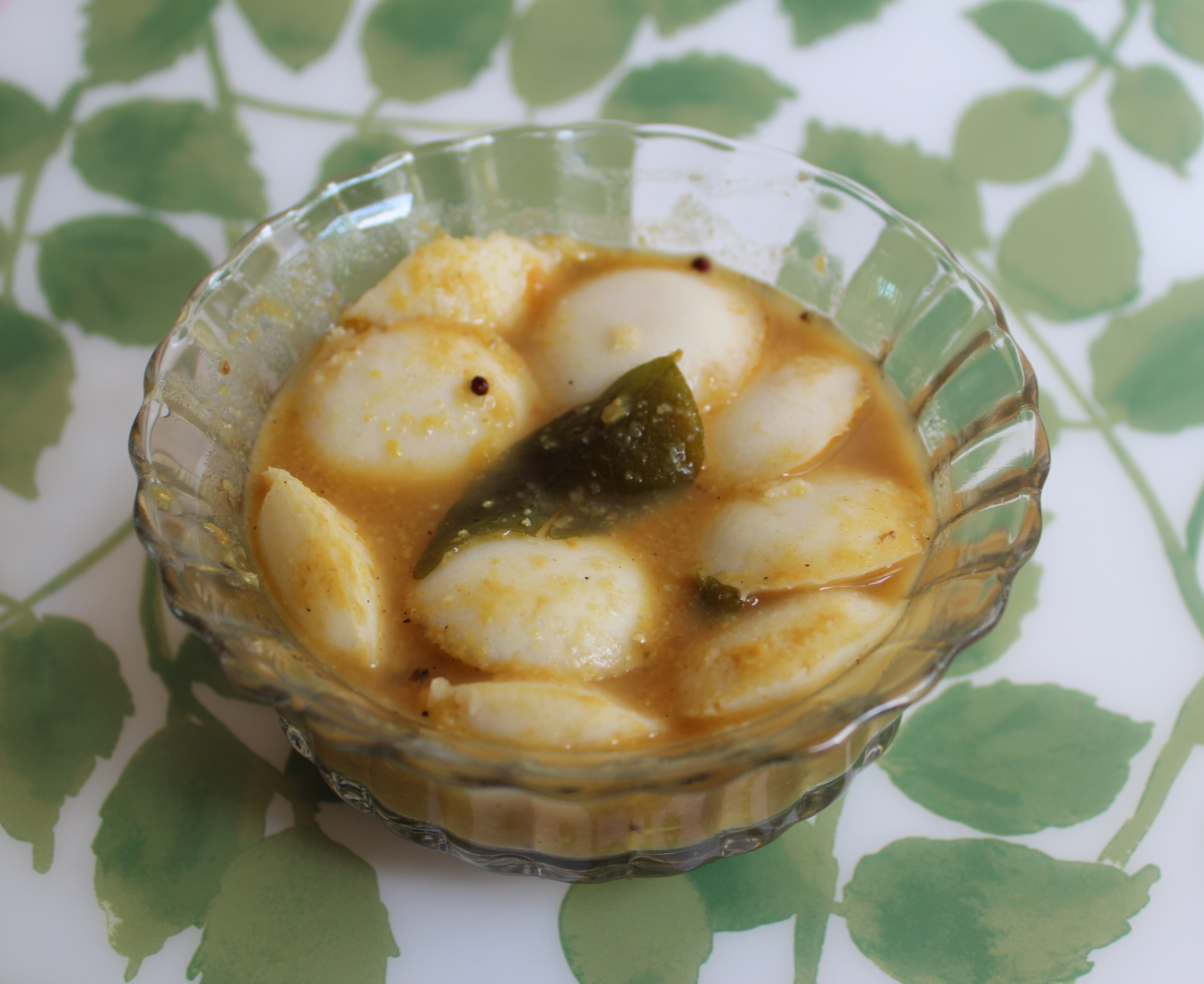
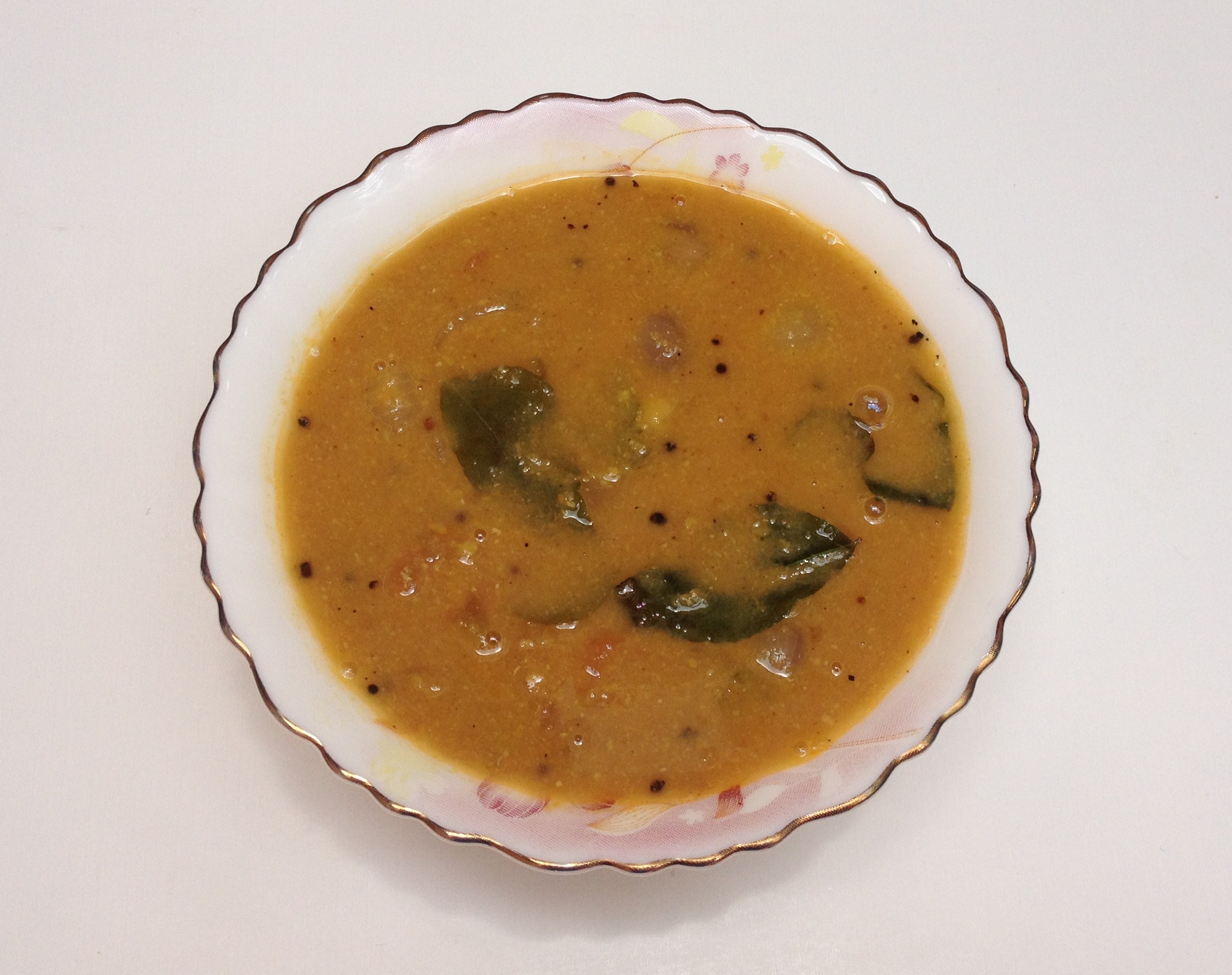
These idlies get a special image lift, when they are soaked in sambar – the tangy lentil curry. The Sambar version can be altered to preferences, spicy, tangy or subtle in flavours or just with more lentle suitable for children. As they are soaked in hot sambar, the soft idlies become softer, easier for elders as well. The sambar here is not the usual sambar, it tastes the best with Araichu Vitta Sambar – Sambar made with freshly ground spices.

Here, I have tried to give the same flavour of Araichchu Vitta Sambar with the same Amma’s Sambar Powder with ground coconut and coriander seeds.

This complete meal is called Sambar Idly – idlies soaked in Sambar. Do not make the mistake of ordering Idly Sambar in a restaurant keeping in mind idlies soaked in Sambar. When it is Idly Sambar, you are served normal idlies with chutney and sambar. When it is Sambar Idly, you got it right!
 

Sambar Idly
 

IMG_1249


Kutty Idlies

Things needed for Kutty Idlies-
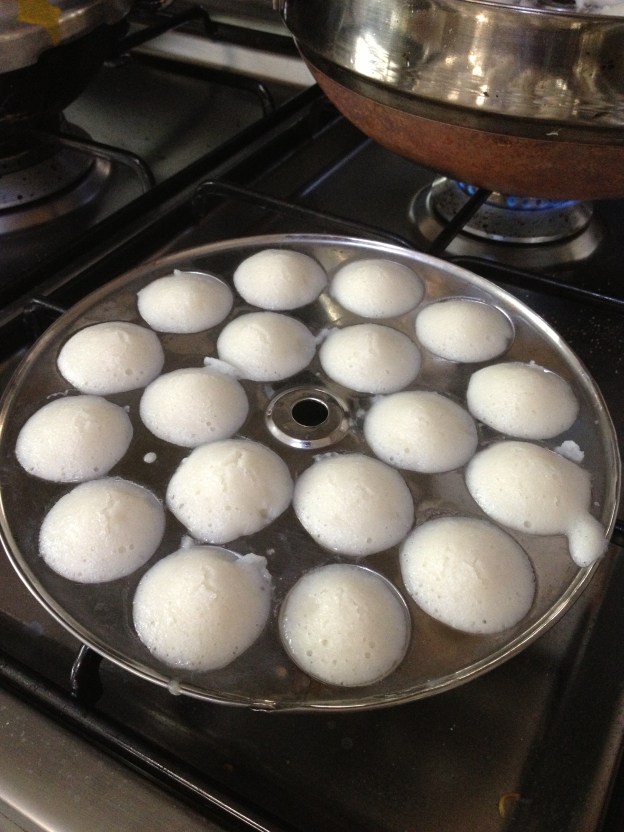
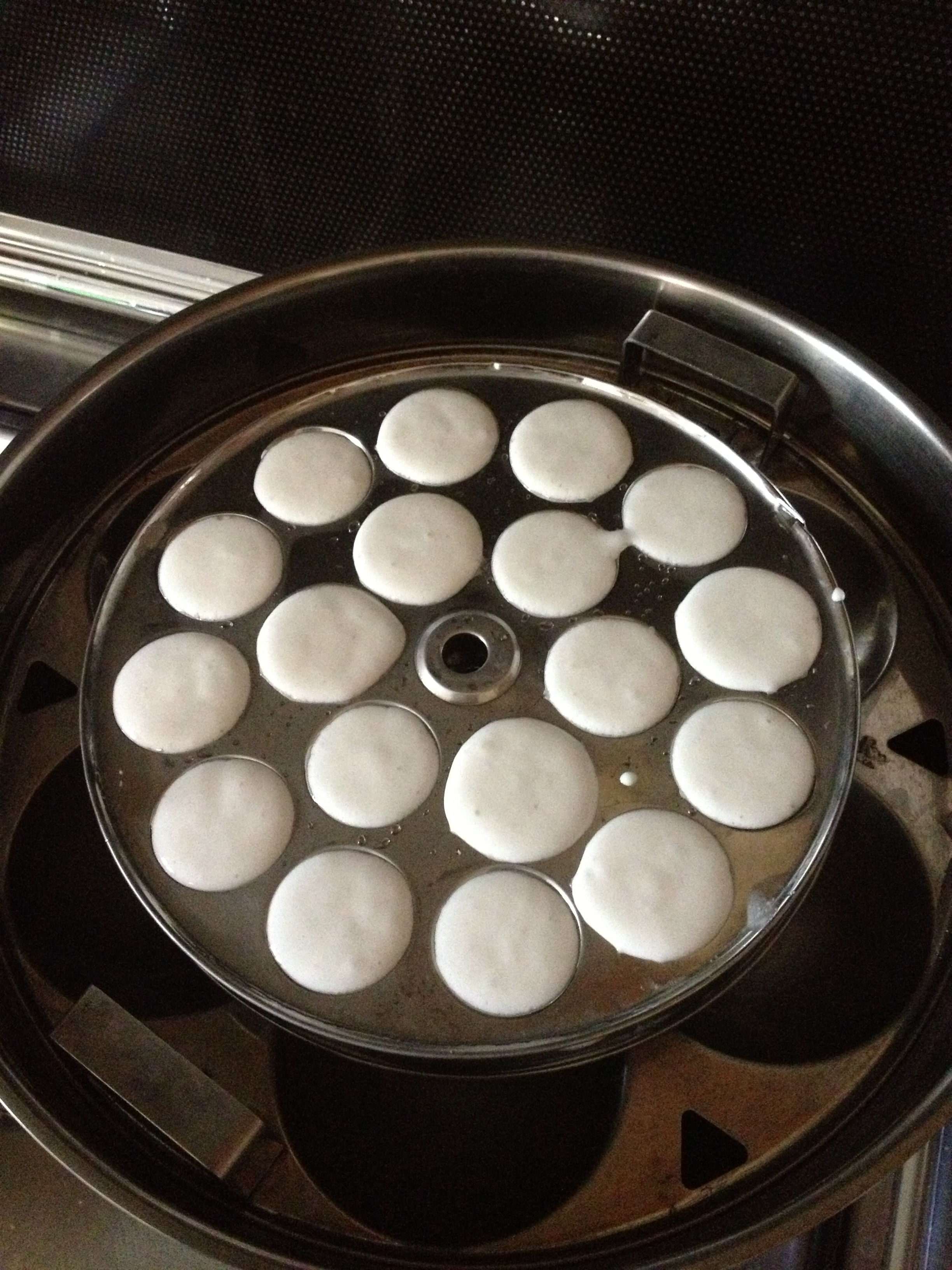
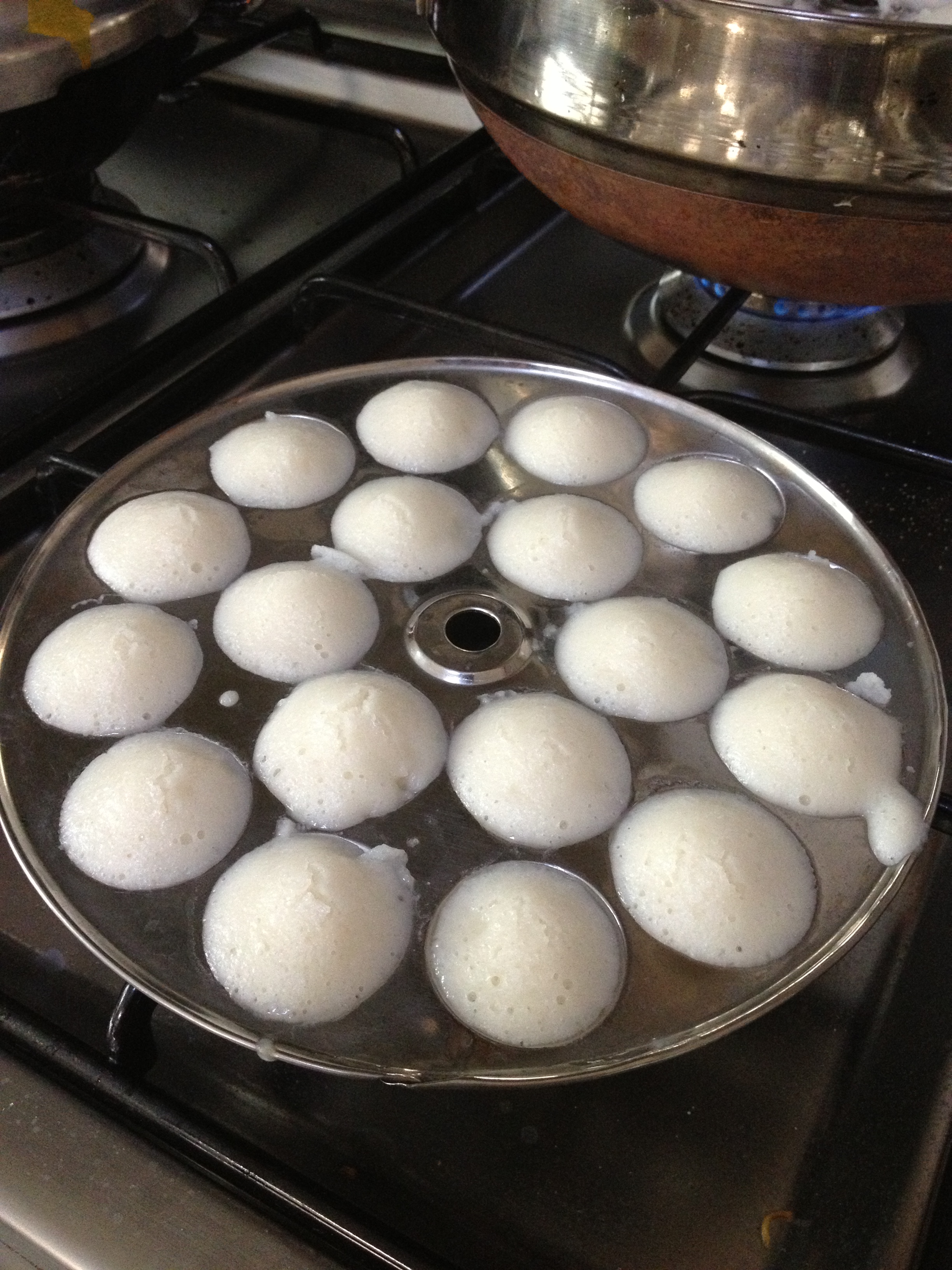
Kutty Idli Mould – mine makes 18
Idli batter – see https://dosaikal.com/2011/09/16/basic-idlidosa-batter
 

fresh batter

IMG_1423


Steam idlies in the mould or those without the mould can use very small bowls as moulds. Or just cut the normal idlies into four or six pieces… the idlies to be soaked in sambar is what matters after all!
 

IMG_1426


Thengai Araitha Sambar
 

  1. We would need atleast 3 to 4 cups of sambar to soak one set of idlis (18)
  2. Check the recipe of sambar at https://dosaikal.com/2012/02/08/sambar. Make 1/2 quantity of the sambar to be enough for soaking idlis
    Make Sambar with no vegetables This sambar is made with only shallots and it is called Vengaya Sambar- In general, the sambar to go with rice has vegetables in it but the kuzhambu/gravy/curry to go with idlies and dosais are made with shallots and no vegetables; keeping all the other ingredients like tomatoes, tamarind, sambar powder and lentils intact
  3. This Sambar is less time-consuming with no added vegetables and shallots cook very fast
  4. Roast 3 tsp grated coconut with 2 tsp coriander seeds till coconut becomes golden brown. Grind into coarse powder
  5. When shallots are cooked in tamarind-sambar powder and the already cooked lentil is added, bring the kuzhambu to a boil. Now, add the ground coconut-coriander powder and let the Sambar boil till the raw smell of coriander is gone
  6. Garnish with coriander leaves and asafoetida and sambar is ready


IMG_1435


Sambar Idly

Place the steamed kutty idlies in a wide bowl and pour hot Sambar and let it soak for at least ten minutes
Serve in small bowls.

The Cambodia Connections- I

Bicycling in the streets of phnom penh, one can sense so much similarity to southern indian places. Being a foodie, my eyes and interest obviously stick to those things I value primary. Like the vegetable market especially… loaded with tropical stuff, even some of those rare fruits amd vegetables that have been our childhood nibblers!

I have tried to capture some… let us enjoy it together!

I gave the title ‘The Cambodia Connections’ and also suffixed with ‘I’. There is an ocean of many more things that would follow in future posts, that could be categorised under the same title.


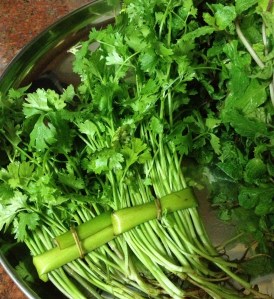
Kothumalli/Coriander

Kothumalli/Coriander is available in plenty. But more than the green, fresh coriander, what attracts the most is the way it has been clipped beautifully with the cut palm leaf or something else I am yet to find out! We call it Kothumalli Kattu is Tamil – it means tied coriander bunch.
 

the beautiful bunch

IMG_0243


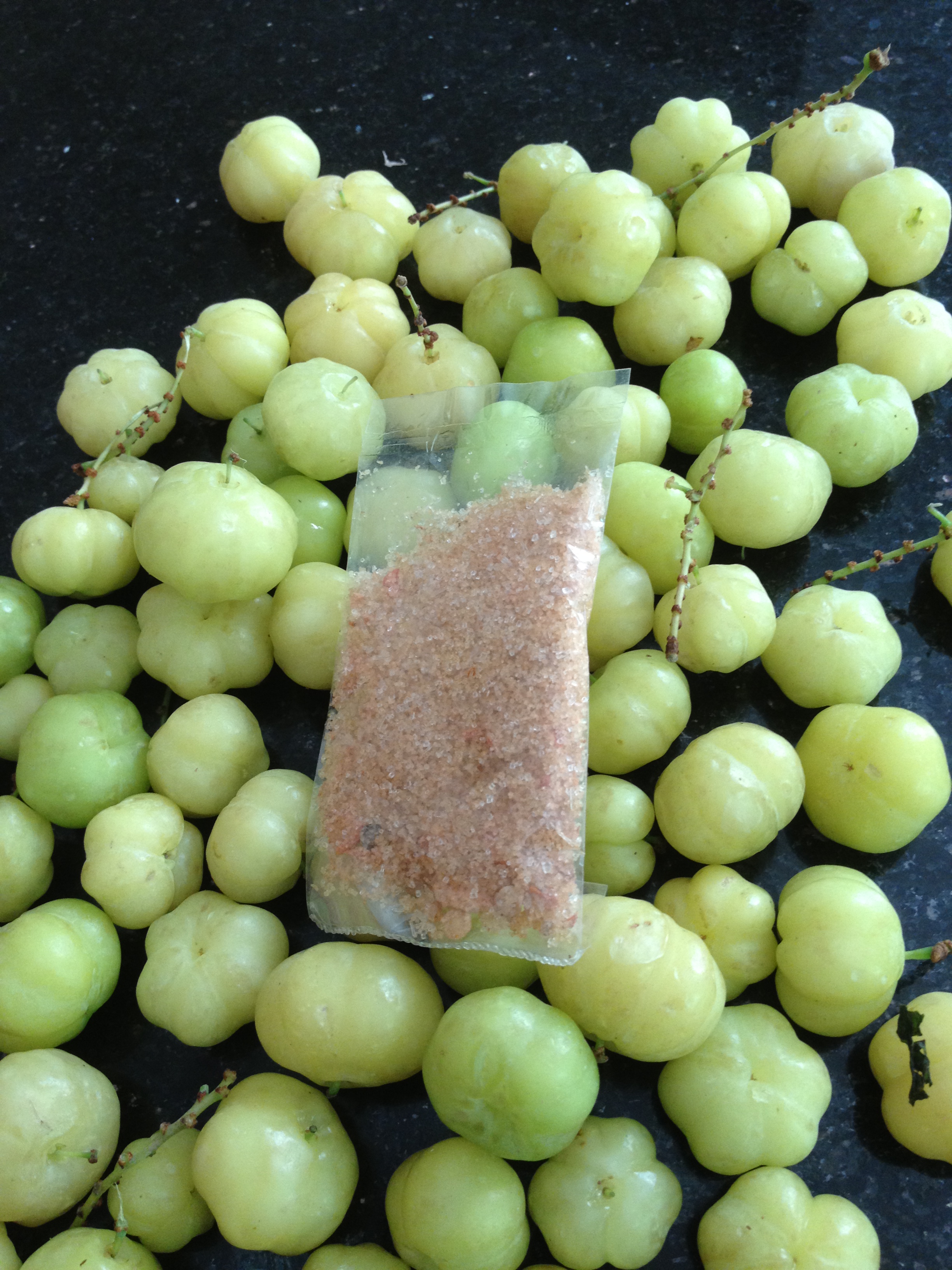
Nellikkai/Gooseberry

Nellikkai/Gooseberry is one of those summer delights which is a sour fruit and when one has a glass of water after, it sweetens ones taste buds.

The health benefits of gooseberry –
 

enhances food absorption, balances stomach acid, fortifies the liver, nourishes the brain and mental functioning, supports the heart, strengthens the lungs, regulates elimination, enhances fertility, helps the urinary system, is good for the skin, promotes healthier hair, acts as a body coolant, flushes out toxins, increases vitality, strengthens the eyes, improves muscle tone and it acts as an antioxidant. http://www.organicfacts.net/health-benefits/fruit/health-benefits-of-indian-gooseberry-or-amla.html

 
While Nellikkai is available in the markets and vendors in bicycles – the packet of salt and red chilli powder that comes with the pack made me feel at home truly….. that’s the way we have our raw fruits like mangoes, guavas and gooseberries.


nellikkai with salt and chilli

IMG_0771


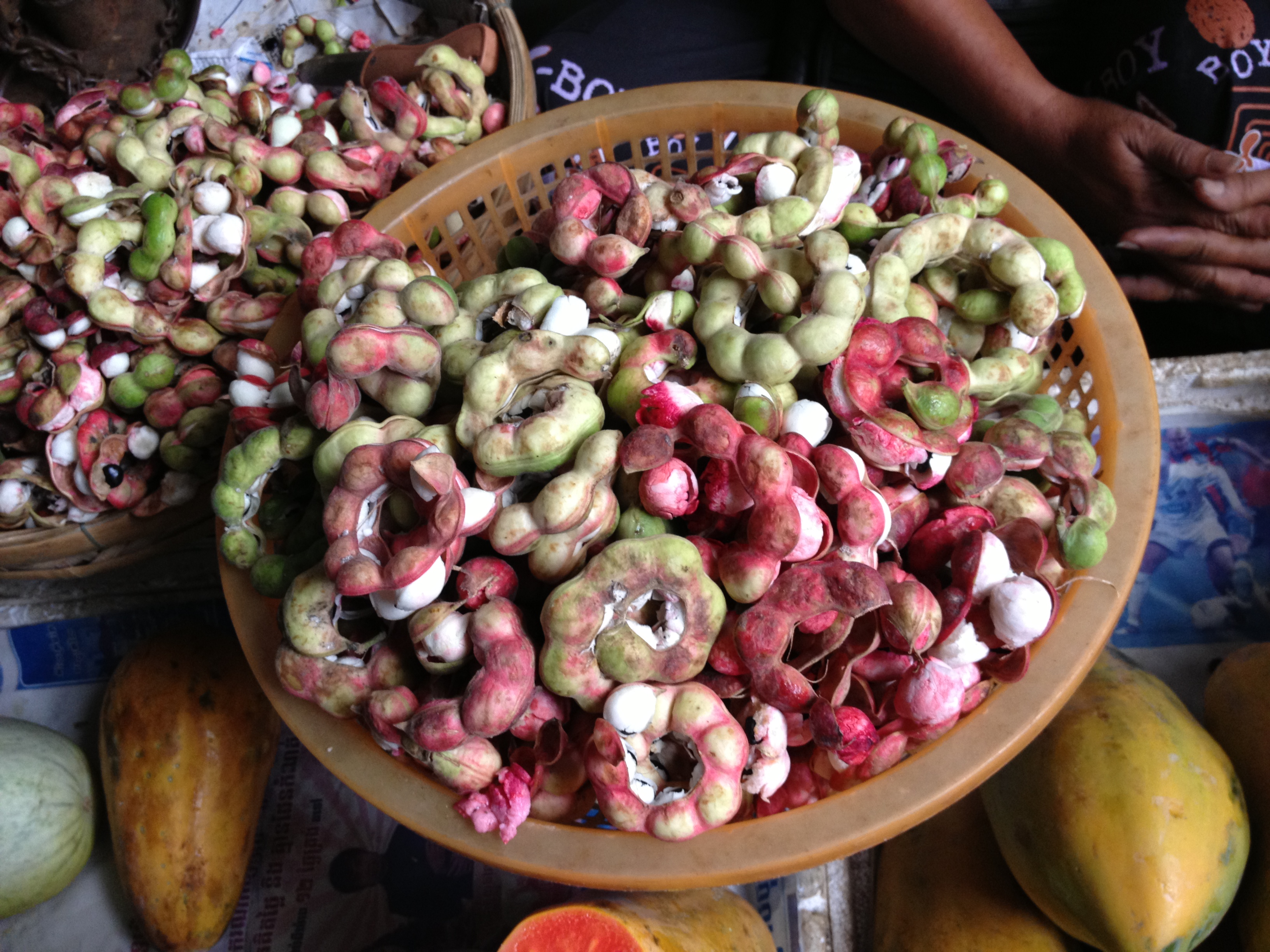
Kodukkapuli

also known as  – Guamachil, Manila Tamarind, Kodukkai Puli/Kodi-kai puli, Sweet Tamarind, Thai-Sweet Tamarind, Madras Thorn, Monkey Pod, Jungle Jilebi, Bilayati Imli, Seema Chintakayalu (Foreign Tamarind), Kona Puliyankai (Twisted Tamarind) http://www.flickr.com/photos/babishvb/5512545340/


Now, I had been searching this for a long time… in Chennai whenever I go on a holiday. But not been able to find it.  This used to be one of our childhood nibblers (if I could call them so) sold out of the school in Thoothukudi. Myself and my cousin who used to come out of school would buy kodukkappalli and nellikkai and munch back home! It is called Kodukkapuli in Tamil and we used to call it kodukkappalli colloquially.

The sweet soury taste still lingers in my tongue.. with some sweet memories too!
 

the twisted tamarind

IMG_0931

 
I could find some interesting facts on this fruit from http://www.flickr.com/photos/babishvb/5512545340/ –

Kodukka puli came from the word Kodi-Kai puli which means Vined Tamarind
* peel the black seeds to reveal a brown coating (not the white ‘main’seed inside) and then string them into bracelets
* The pod/pulp is widely used in the tanning industry. Camachile bark used almost exclusively by Filipino tanners
* Used as good timber
* Mucilaginous gum
* Used for preparing yellow dye


The Manila tamarind fruit is low in calories, and including it in your diet can help you meet your daily fiber, vitamin C, iron, calcium and potassium needs.

It promotes normal bowel movements, controls hunger and lowers your risk of heart disease.

It is also an important antioxidant, protecting your cells from free radicals, which can help reduce your risk of heart disease and cancer. http://www.livestrong.com/article/497683-the-nutritional-value-of-manila-tamarinds/


Thengai/Coconut

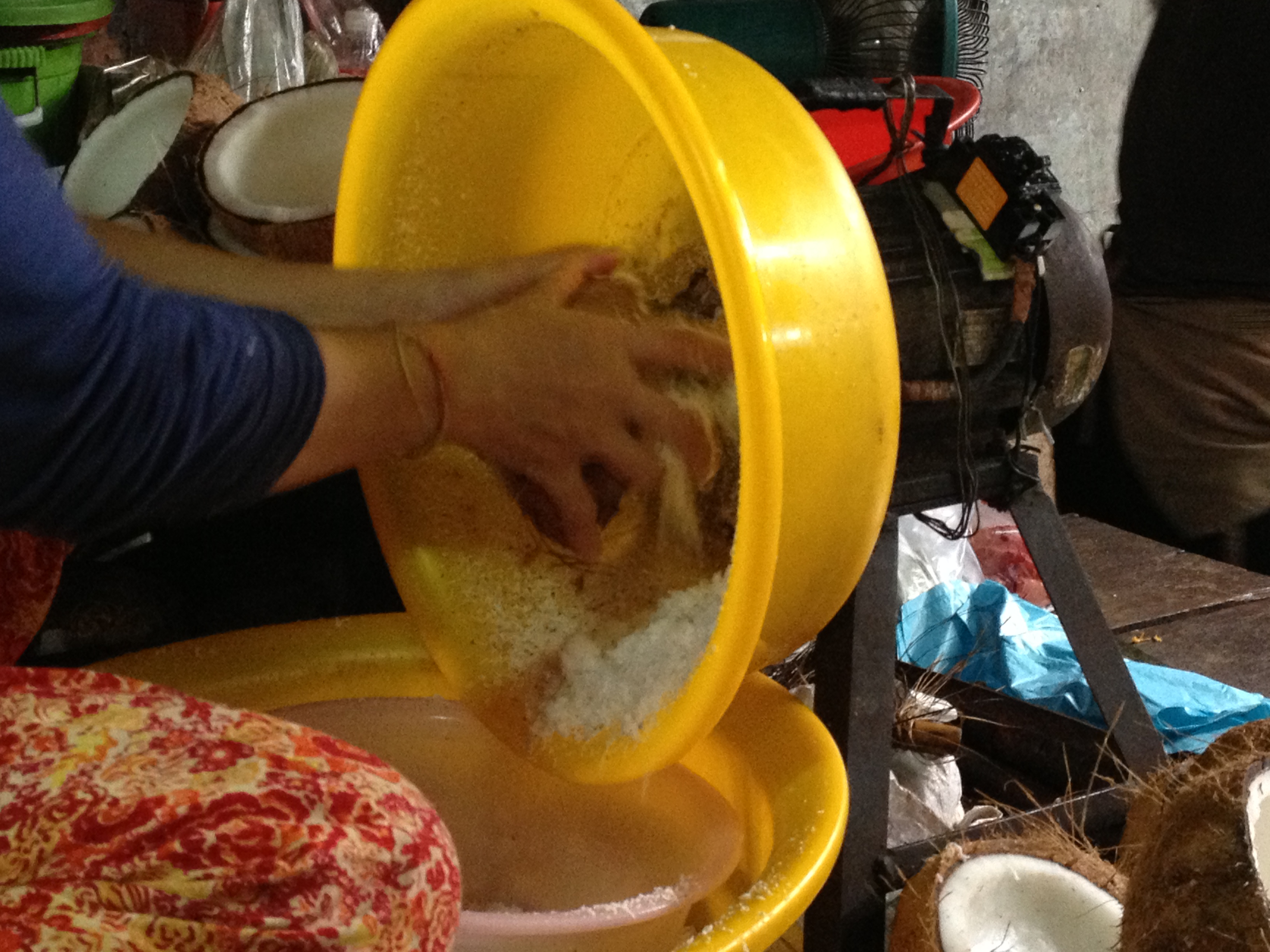
The south of India uses more coconut in cooking. Buying coconut and grating in not a problem anymore. In the market, you choose your coconut and the vendor grates it in front of you. It looks like an indigenous coconut grating machine made from local items.. very interesting!
 

the machine

IMG_0937


coconuts grated

IMG_0939


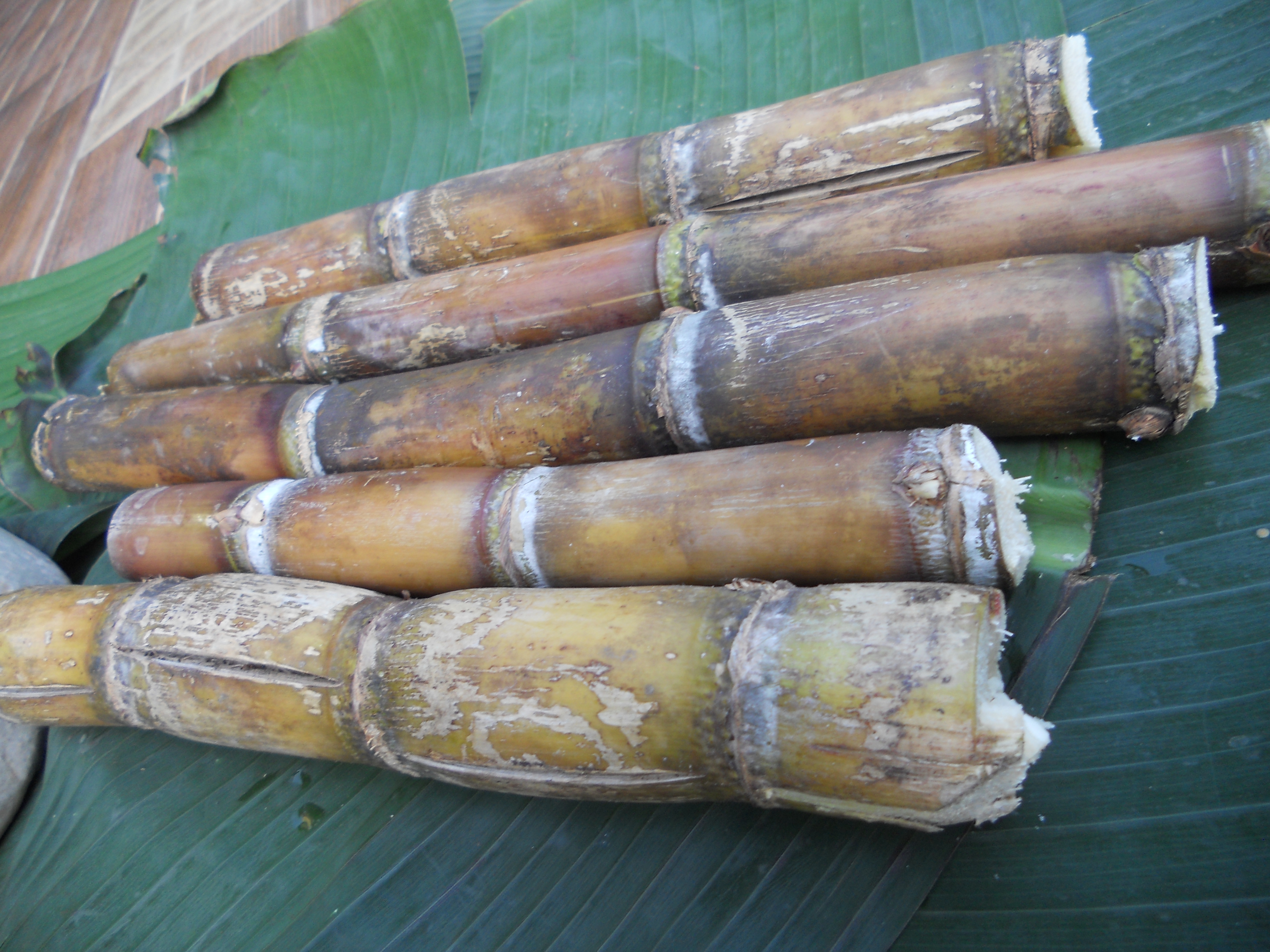
Karumbu Chaaru/Sugarcane Juice

On a humid, sunny, sweaty day, a glass of sugarcane juice can provide instant energy. Karumbu Chaaru in Tamil. Karumbu is sugarcane and Chaaru means juice. In the streets of Phnom Penh, one can find these small carts/machines and the juice is sold in disposable glasses… covered in a small plastic bag – easy to be hung in cycle handlebars or be placed in water bottle holders in bags. There are also halves of lemon squeezed between the canes while they are being pressed… I think in India, it is also a bit of ginger added while the juice is pressed…if I am right.

The only problem is the glass would first be filled with icecubes it can fully hold and the other approximately 3 or 4 ladles of juice would fill the glass… great chiller ofcourse but solely due to ice. Pay double or triple and you get the same glass full of juice… but my sugarcane lady is very friendly though.. she insists I take ice in the outer bag and she places the closed full juice glass in the ice bag and we reach home with undiluted ice cold karumbu chaaru/sugarcane juice!

the machine

IMG_0826


stored sugarcanes and the juice

IMG_0824


It is truly a warm feeling of being at home!   An exploration of more cultural and cuisinical similarities between the Tamils and the Khmers! I shall try my best!

It is Tamil Puthaandu/Tamil New Year on April the 14th. The Khmer New Year called Chaul Chnam Thmey (means Enter New Year) is celebrated for 3 days starting April 13 to April 15.

Puthaandu Vazhthukkal! Happy New Year!

Suo Sdey Chnam Thmey!!

Varutha Meen, Varutha Kathirikkai with Thaalicha Paruppu/ Pan Fried Fish and Pan Fried EggPlant with Seasoned Lentil


the platter

IMG_0788

Why not try this for a simple sunday meal or even a relaxed saturday meal? Steamed Rice – Thaalicha Paruppu with varutha meen – pan fried small fish and varutha kathirikkai – pan fried spicy eggplant!

Here we get small river fish – which my daughter loves when pan fried… but when cooked in gravy, it is a tedious affair to remove bones. Especially with an inexperienced, recently converted non-vegetarian mother like me.

Cambodia’s inland fisheries are the fourth most productive in the world given the combined capacities of the Tonle Sap (Great Lake) and the Mekong River, where more than one million people depend on the fisheries sector for employment, income and food security.  Thailand is the largest importer of freshwater fish from Cambodia. http://www.genderandtrade.org/gtinformation/164419/164436/165013/thailand_combodia/

The fish is very quick to make and so is the eggplant – ofcourse the eggplant needs some cutting but the fish – might have been moulded the right size straight from heaven!


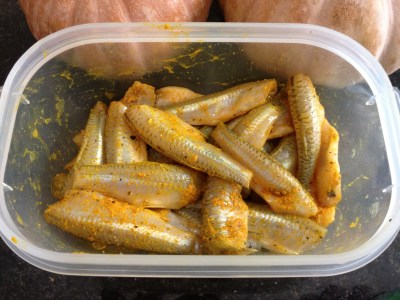
marinated fish

IMG_0742

Coming to the platter – I just made Steamed Rice and Thaalicha Paruppu (quick-and-easy-thaalicha-paruppuseasoned-lentil) for the main course. As south indians, we always mix up the rice with the lentil or any gravied curry. And compulsorily need a side dish – be it semi gravy kootu(stew of vegetables) or a dry vegetable to have with the mixed lentil and rice.

Now enters the fish and eggplant as side dishes or accompaniment to the main course or the only course on a lazy weekend – lentil and rice. The marination can be an insult to true marination – as in the true sense, we sprinkle the spices and fry – but – a lazy day’s true treat – without doubt!


I. Varutha Meen – Pan Fried Fish

IMG_0949


Ingredients

  • chiriya Meen/small fish – 1/4 kg (has appr. 25 fishes)
  • cooking oil – 5 tbsp (for frying)
  • gingelly oil – 2 tsp and curry leaves – a few for seasoning

to marinate

  • turmeric – 1/4 tsp
  • pepper powder – 1/2 tsp
  • salt – 1/2 tsp or as per taste

Method of Preparation
  1. Clean the fish and apply salt and turmeric and leave it for 15 minutes. This is believed to help in effective cleaning of any fish before cooking
  2. Wash well again and then mix in the marinade
  3. To check salt, mix turmeric, pepper and salt separately and taste for salt and spice and then mix the fish in the spice mixture
  4. Set aside for a minimum 1 hour in fridge
  5. Heat oil in pan and place the marinated fish
  6. Fry till the fish gets the brownish glow and is crispy
  7. Remove in absorbent paper
  8. Heat 1 tsp gingelly oil in a pan – might be the same pan
  9. Add the washed curry leaves and fry
  10. Place the pan fried fish in a serving bowl
  11. Garnish with the fried curry leaves.

in the pan

IMG_0423


done!

IMG_0429


II. Varutha Kathirikkai – Pan Fried EggPlant

IMG_0791

Eggplant is very low in calories and fats but rich in soluble fiber content.  The peel or skin (deep blue/purple varieties) of aubergine has significant amounts of phenolic flavonoid phyto-chemicals called anthocyanins.Scientific studies have shown that these anti-oxidants have potential health effects against cancer, aging, inflammation, and neurological diseases.

It contains good amounts of many essential B-complex groups of vitamins such as pantothenic acid (vitamin B5), pyridoxine (vitamin B6) and thiamin (vitamin B1), niacin (B3).Further, this vegetable is an also good source of minerals like manganese, copper, iron and potassium. http://www.nutrition-and-you.com/eggplant.html


Ingredients

  • kathirikkai/Eggplant – 2 no.s (I used the long ones)
  • cooking oil – 5 tbsp or a little more

to marinate

  • turmeric – 1/4 tsp
  • salt – as needed
  • red chilly powder – 1 tsp
  • coriander powder – 1 tsp

Method of Preparation
  1. Wash eggplant and cut into 1 inch thick pieces
  2. Keep the pieces in water or the eggplant tends to darken
  3. When you are ready to marinate it, take out of water and mix the spices and leave for 15 minutes
  4. As usual heat oil in a pan and fry till done on both sides.


marinated eggplant

IMG_0941


in the pan

IMG_0943

Serve fish and eggplant with steamed rice and thaalicha paruppu. There is always Yoghurt at home and that helps to end the day’s meal with thayir saadham – that is just plain yoghurt and rice!


Note:
  1. The quantity of spices can be altered as per taste of the family
  2. Fish can be used with the head or without. I use them without the head
  3. A dash of lemon juice while marinating gives a wonderful flavour in both; or just add after the fish is crisply done.
  4. Lemon juice after the eggplant doesn’t suit much though.
  5. For marination of eggplant, sambar powder can also be used for even more lazier ladies (I do it sometimes)!

Call it a Simple Sunday Meal and why two dishes? Do some of you feel this way – just opt one per week! Sometimes I feel guilty when my daughter asks why is there a lot of empty space in her plate….. in search of more side dishes! Now, with fish and eggplant her plate was not empty!!

Why even cook the thaalicha paruppu/seasoned lentil? It happens my friend… tttooo lazy for anything. Take that Plain Yoghurt from the fridge… Have you cooked your rice atleast? Make Thayir Saadham/Curd Rice (thayir-saadham-mor-milagaicurd-rice-sun-dried-chillies) or just mix Rice and Plain Yoghurt on the lunch table. Enjoy with fish or eggplant!! A sumptuous meal and some rest too!

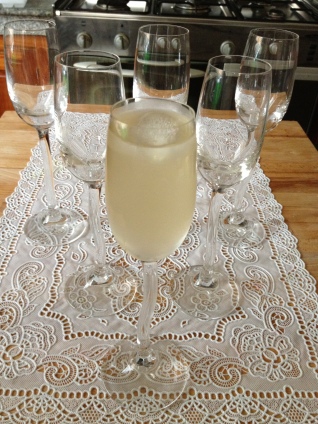
Mint Cooler – Pudhina Kulir Chaaru

 Unpacking still continues.. Unpacking, Arranging and Setting up a new house in a new country is supposedly a never ending task – atleast feels so for now. But Kitchen cannot stop running…  but Posting has taken a slow motion twist. But let me tell you, life looks like an action packed thriller – not at all an Exaggeration Please… never under estimate the life of a Home-maker!
 
Hats Off to my fellow bloggers who don’t let their packing, unpacking and settling down bother blogging and sharing!
 
That is why I decided for this Quickie Post. This is a thirst quencher, that goes down so cool and comfortable and certainly is a digestive soother.
 
Even in these busy times, we have been able to travel to the best attraction of Cambodia – Angkor Wat.  This travel not only took us to the past but also develop an interest in the connections Indian Kings, especially the Tamil Kings had with Cambodia and South East Asia, very many centuries ago. I think after some serious research, I shall try to deliver in words the beauty and ethnicity of this historic country.
 
Back to the thirst quencher.  Here, the temperature varies between 30 to 35 degrees C in the daytime and might be 25 to 27 degrees C at night. It is important to keep drinking water and provide necessary fluid supply to the system, especially for kids who have their PE (Physical Education) classes at nearly eleven in the morning till 12 before lunch. Also for mothers like me who take a trip to school to drop the lunch box, packed with fresh lunch for our children. (There is always a doubt whether the food would remain fresh if sent by hand,  the children leave home by seven as the school starts at 7.30 am).
 
This drink is truly a chiller! I had it in a restaurant in Chennai during my recent visit. Couldn’t stop with a single glass of the drink… it gave an instant soothing feeling in the scorching chennai humidity. Why not call it Minute Cooler instead of Mint Cooler?! It is not only an instant cooler of the body but is made in a jiffy too.
 
I named it Pudhina Kulir Chaaru – Pudhina is mint; Kulir is cool or cold and Chaaru is juice.
 
Good Luck struck me when I came to know my cousin makes it regularly at home. Got the recipe from her and it is a regular at my home (made it twice already).
 Though it seems to be more of a summer chiller, this is for all seasons. A drink is a drink isn’t it? Meant for all seasons!

 Thankyou Akka!!


IMG_0888

   
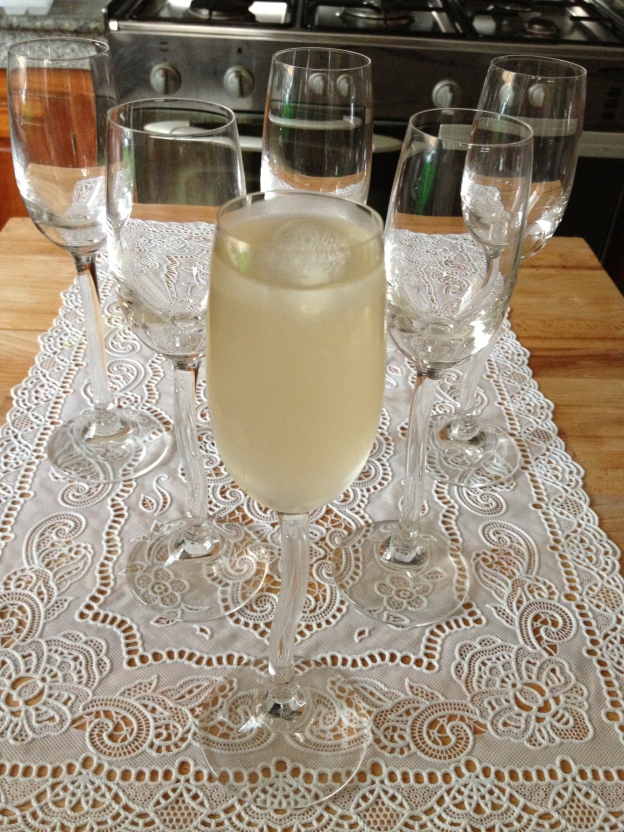
  Mint Cooler
    

Ingredients

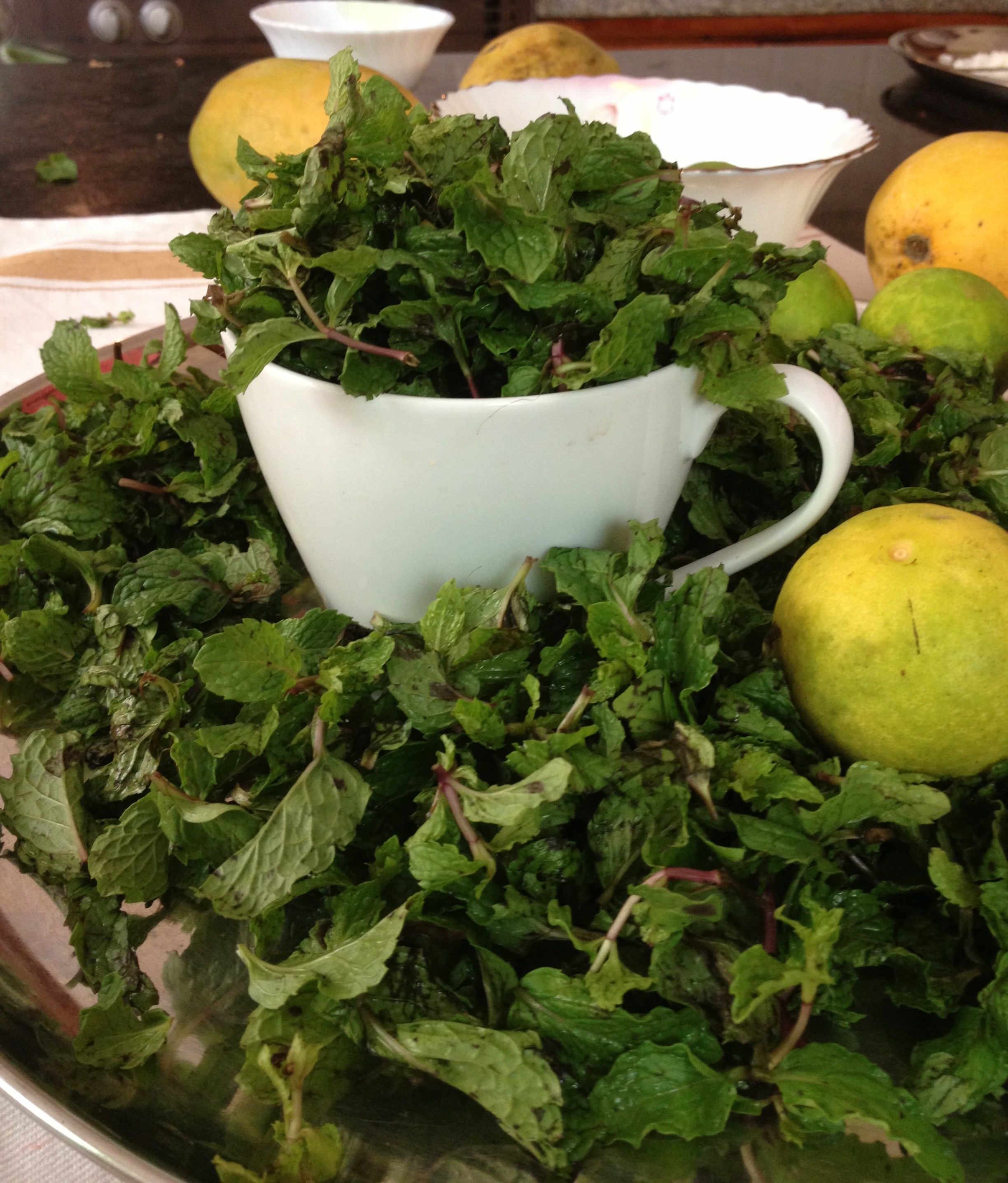
  • fresh mint leaves – 3 1/2cups
  • water – 500 ml (appr.. 3 cups)
  • sugar – 250 mg (appr. 2 cups)
  • grated ginger – 3 tsp
  • lemon juice – 1/4 cup


mint leaves

IMG_0801


lemon and ginger

IMG_0803


    Method of Preparation

  1. Clean and wash mint leaves
  2. Peel, wash and mash ginger coarsely
  3. Heat water and sugar in a wide bowl and bring it to boil and switch off the stove
  4. Immedietely add the mint leaves and ginger
  5. Mix well and close with lid
  6. Let this cool for atleast 3 hours
  7. After a minimum of three hours, the mint leaves would have released a pleasing flavour and mild colour to the concentrate
  8. Ginger would have left a very slight spicy taste
  9. Let the mixture cool well to add lemon juice
  10. Squeeze juice of approximately 3 lemons depending upon the size of lemon
  11. Add the lemon juice to the sugar mint concentrate
  12. Strain in a small holed strainer and store in fridge
  13. Mint concentrate is ready and stays for a week in fridge.


concentrate

IMG_0809


Preparation of Mint Cooler

  1. Take any preferable glass
  2. Add crushed ice or just ice cubes
  3. Fill 1/3 portion of the glass with concentrate and the rest with water
  4. Ready to be served!

  
    Note:

  1. Quantity of Mint leaves can be increased for a more minty flavour
  2. The same holds good for sugar, ginger and juice of lemon according to one’s taste buds
  3. Always add lemon juice only after syrup cools well as lemon juice would turn bitter if added in hot syrup
  4. Green food colour can be added for an exact colour to the Mint Cooler (I have not used green food colour as I prefer not using additional colours)
  5. To store the concentrate longer, citric acid can be added. Here, I have added only lemon juice and avoided citric acid.
  6. This concentrate can be stored in fridge for a week. Take my words, it will be done before the time frame!
  7. Cousin ‘S’ also mentioned, for a more tangy north indian flavour, chat masala can be added while serving.

    Enjoy!!

Pongal in Cambodia with AVIAL!


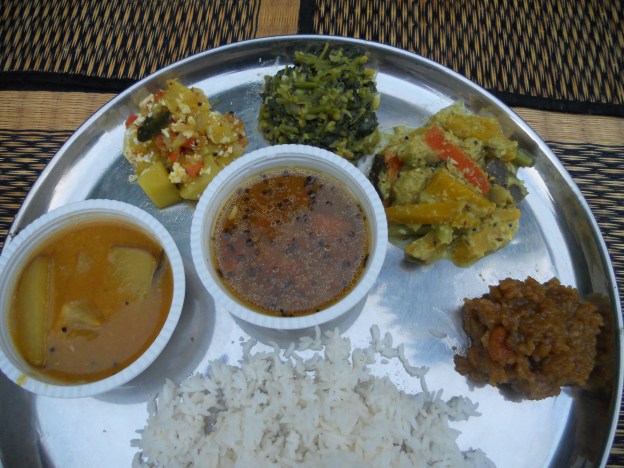
my pongal platter

DSCN1219

  • In the plate: Cooked Rice, left bowl – Mangai Sambar (Raw Mango Sambar) , next bowl – Thoothuvalai Rasam (SOLANYMTRILOBATUM Soup) , right corner – Sarkkarai Pongal (Jaggery Rice) ;
  • three of the side dishes – up left corner – Pappalikkai Poriyal (Raw Papaya Dry Vegetable Curry), middle – Keerai Kootu (Spinach Stew) and next – Avial (Mixed Vegetables in coconut and curd gravy)


Wishing you all a very happy and success filled NEW YEAR 2013! Thankyou for being such wonderful readers. For me.. each one of you have made this world a delightful arena to share my thoughts.

For those who would have wondered why there has been no news for quite some time.. I was busy planning, listing, shopping and packing my groceries, clothes and other necessary and unnecessary stuff to carry to my next destination!

Leaving some beautiful memories behind in Thoothukudi and Chennai (apart from those special moments I’ve brought with me..), here i am, in my new place, slowly trying to settle down.  New house, New school for my daughter, New shopping area, New vegetable market,  everything new, except for the same old cooking….. idlies, dosais, chutney, sambar, rice, kuzhambu and the normal list of courses that follow in line! But a new kitchen.. with bare minimal utensils, those of mine yet to arrive from the Netherlands.. I have managed a few clicks this time!!


It is was Pongal time! Sankaranthi to other states and Thai Pongal to Tamilnadu!! (https://dosaikal.com/2012/01/13/thai-pongal-the-harvest-festival/)

In this new new new life, number one – I mis-calculated the date of Pongal and thought it was on the 15th of January. When I called home to ask for the vegetables for AVIAL – a special down south vegetable dish to make on Pongal day, I had a shock that it was actually the festival Pongal the same day!! Number two – With some other programmes to attend, I decided I would celebrate Pongal on 15th… not to stop the rice boiling ritual that is exclusive part of Pongal celebration. The word ‘Pongal’ itself means ‘to boil’. Paal Pongiyaacha? means has the milk boiled? Here, the sweet jaggery rice made on the day of the festival Pongal is called Sarkkarai Pongal meaning sweet pongal.

There would be two Paanais/vessels. One with plain white rice and water and the other with plain white rice and when it boils, jaggery is added to make Sarkkarai Pongal – the sweet jaggery rice – the delicacy associated with the festival. When the new rice boils and spills over the paanai, women of the house say – ‘Pongalo Pongal’ in chorus. https://dosaikal.com/2012/01/13/thai-pongal-the-harvest-festival/

This time, instead of the pressure cooker pongal, I had brought a steel Paanai to make my Pongal celebration.

steel paanai and jaggery in the adjacent bowl

DSCN1179


15th of January is the third day of the four day Pongal celebration. First day being Bhogi – cleaning of house and shedding away old unwanted things; the second day is the harvest festival or the thanksgiving to farmers – this Pongal day is the first day of the month of Thai; the third day is Maatu Pongal – thanksgiving to cattle that help in harvest; the fourth day is Kaanum Pongal – the Picnic Pongal!!

As such, when we were young, my mama (maternal uncle) would always ring us up early in the morning on Maatu Pongal day, to wish us Happy Maatu Pongal – a teaser for kids. So Mama, this time I go by your words… I truly celebrate Pongal on Maatu Pongal Day!

So now, in the capital of Cambodia – Phnom Penh, when I saw those sugarcane juice shops which extract fresh juice like those in chennai, I felt delighted… Now, i was in a country where I could buy sugarcane, which is an inseparable ingredient for the true taste of pongal festival. I bought two to keep on either sides of my house entrance.


IMG_0249

and later, the transformation till it reached everyone’s taste buds…..


DSCN1194


the way aachi cuts

IMG_0311


Next, I had to hunt for those harvest vegetables … The traditional, indigenous ones grown inland! My grand plan was to make AVIAL – the humble yet classy dish of Tamilnadu and Kerala.

Avial is a sumptuous combination of all indigenous (ofcourse carrots and beans have become part of it) non-watery vegetables, harvested during the season… made to a semi gravy consistency with the addition of curds and coconut-chilli-cumin paste. Vegetables like ash guard, bottle guard are not used as they shed water while cooking and would hinder the consistency of the dish.

I went to the big kaaikari chandhai – vegetable market in Tamil.. which we had explored couple of days ago and got lost while searching a way to come out. Where all vegetables, fruits, unknown varieties of meat and fish (remember I am still a beginner especially a recently converted non-vegetarian!), freshly grated coconut and many small eateries serving various other unknown food varieties, which I need to explore in the near future!

the ones I could get

DSCN1188


I found a few of those I needed … I could not get yam … wasn’t available. Even if they were, I have not yet learnt the differentiation! Others that I missed but can be added in Avial are Avarakkai – Hyacinth Beans, Murungaikkai-Drum sticks, Pudalangai-Snake Guard.

I was so happy to also find more and more of the tropical fruits that I used to love in Tamilnadu…

DSCN1199


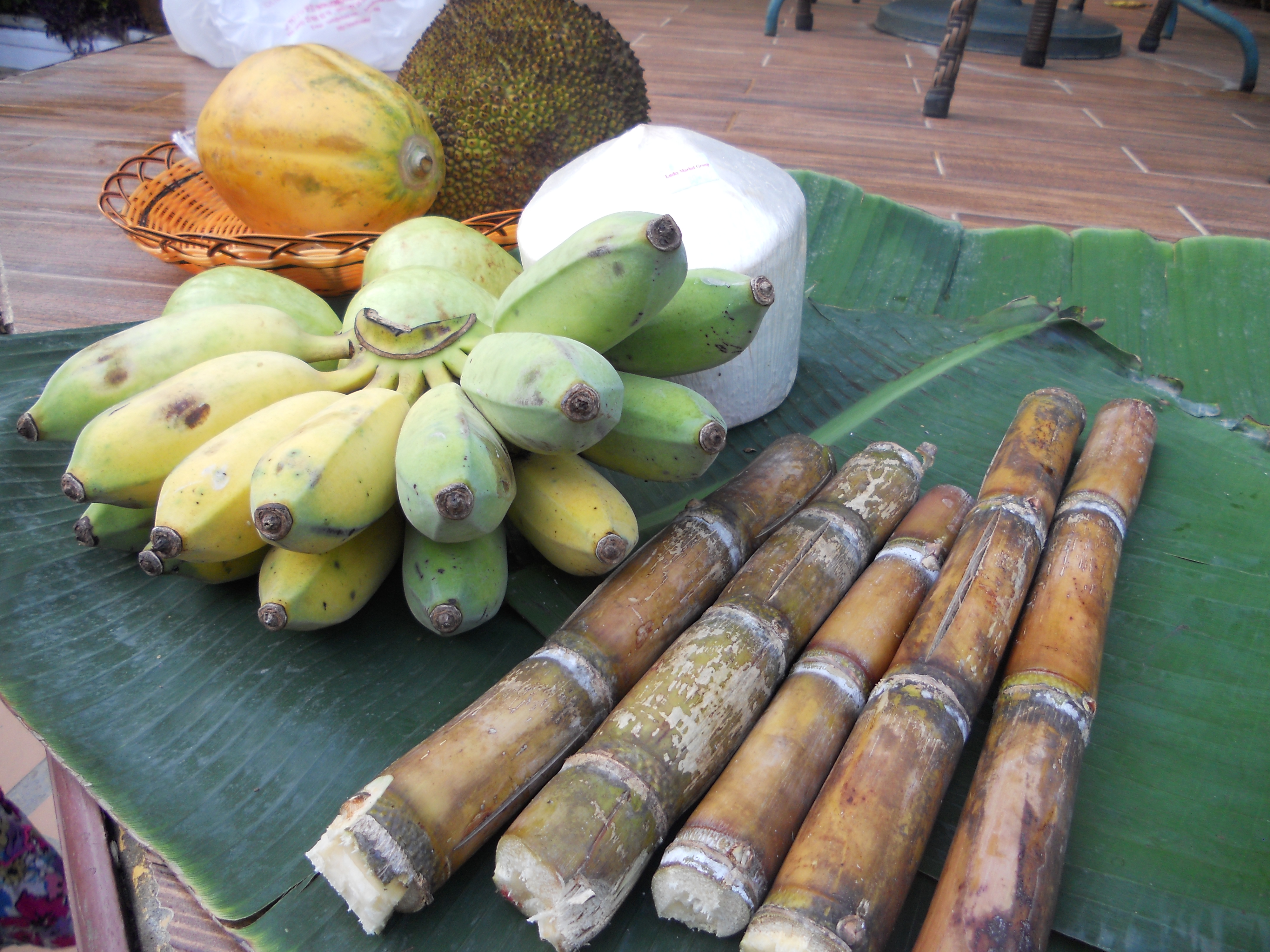
(bananas, guavas, sugarcane, papaya, tender coconut and jackfruit…  and Oh!! I missed those beautiful yellow mangoes kept in the fridge).


Now, before coming to the recipe of Avial… festive sweet of the day – my Sarkkarai Pongal- this time the authentic pacharisi (raw rice) and vellam (jaggery) in the pongal paanai, without the addition of split green gram. https://dosaikal.com/2012/01/13/thai-pongal-the-harvest-festival/

on the way

DSCN1192

the special festive food –  mangai sambar and thoothuvalai rasam

DSCN1193


Though delayed by a day, I tried making a simple feast meal with mangai -raw mango sambar (https://dosaikal.com/sambar/) and thoothuvalai rasam ( SOLANYMTRILOBATUM) a herb found in many kitchen gardens.. I got the dry powder from my naatu marundhu kadai- traditional tamil medicine shop.  (Rasam is a thin soup not used as an appetiser as popularized outside the south of India and abroad, but is a digestive soup. https://dosaikal.com/2011/10/14/thamizhar-virundhu-feast-of-the-tamils/). For the side dishes, Keerai/Spinach Kootu  (a stew of vegetables) and pappali kai/raw papaya poriyal (dry vegetable curry) and AVIAL.


AVIAL


Ingredients

  • mixed vegetables – carrots, beans, egg plant, chow chow\chayote squash, pumpkin, raw banana and potato – 2 to 2 1/2 cups – cut into long pieces
  • shallots – 6 no.s
  • yoghurt – 1 cup
  • grated coconut – 1 cup
  • green chillies – 3 no.s
  • cumin seeds – 2 tsp
  • oil (preferably gingelly oil) – 2 tsp
  • mustard seeds – 1 tsp
  • dehusked black gram – 1 tsp
  • curry leaves – a few
  • turmeric powder – 1/2 tsp
  • salt – to taste

vegetables cut long

DSCN1209
coconut paste and yoghurt

DSCN1210

Method of Preparation

  1. Wash and cut the vegetables into long pieces
  2. Steam the vegetables till done. I do it in a microwave steamer for about 8 minutes. Vegetables should not be mushy, but just right to stir well with the gravy
  3. Make a paste of grated coconut, cumin seeds and green chillies and keep aside
  4. Heat oil in a wide bottomed vessel; Let mustard seeds splutter, then add dehusked black gram and curry leaves
  5. Add the shallots and stir fry for a minute till they become opaque
  6. Now add the steamed vegetables and turmeric powder
  7. Usually turmeric powder can be added while the vegetables are cooked in pressure cooker. This helps the raw smell of turmeric powder go away faster. Since I steamed in microwave, I added the turmeric powder while stirring in the vegetables
  8. Stir for a while and add yoghurt and stir
  9. When yoghurt has blended well with the vegetable, add the ground paste and salt
  10. Let this cook till the vegetables are cooked well and absorbed  in the coconut and yoghurt gravy
  11. When a semi thick consistency is reached and the raw smell of turmeric and coconut has gone off, Avial is ready.

IMG_0296


Note:

  1. Vegetables like egg plant or pumpkin might become mushy very quickly. It is better to cook them just right. When they cook again in the gravy, soft texture would arrive.
  2. Cooking the vegetables in coconut paste and yoghurt gravy and adding thaalippu/thadka/seasoning in the end can also be done. By this method, mustard seeds and oil would glow on top of Avial and the dish is better presented.
  3. Vadagam – sun dried onion balls (which contain mustard seeds, curry leaves and other seasoning imgredients) is added in the end instead of seasoning which gives Avial a remarkable flavour.  In the absence of vadagam, coarsely chopped shallots are fried dark brown in oil and added for nearly the same flavour.

A Visit So Special!

Isnt it a wonderful feeling to go to your birth place!

My train journey started in Muthunagar Express, also called or nowadays often called Pearl City Express, taking us to Thoothukudi, which is believed the Portuguese converted to Tuticorin for easier tongue twisting(?!).

A short detail on the city –


History of Port


In Literature, the earliest mention has been made in 88 AD in Greek work “Periuplus of the Erythrean Sea”. In AD 124, the earliest reference was made by Ptolemy who has observed – “Country of Kareoi, in the Kolkhic Gulf, where there is a pearl fishery, Sosikourai and Kolkhoi, and emporium at the mouth of the river Solan”. There is little doubt that Ptolemy’s Sosikuorai is no other place than Tuticorin. From AD 200 to AD 1000, no records pertaining to Tuticorin are available. http://www.vocport.gov.in/port_history.aspx


the sea


Rulers in various centuries


The 7th to 9th Century AD were ruled by Pandya Kings and 10 to 12 Century AD it was ruled by Chola Kings. There is a mention that there was a well guarded and natural Harbour where ships could anchor in safety in Tuticorin. Portuguese, Dutch and British ruled India in different time frame. Portuguese sailed into Tuticorin in 1532. In 1649, Dutch captured Tuticorin. Many European visitors particularly English travelers have meticulously recorded their impression of Tuticorin in 17th Century. The impression recorded by Philip Baldaeus, an English missionary, who visited Tuticorin in 1675 are graphic and valuable. The lucrative pearl fishery that flourished under the Dutch is vouchsafed by Jean De Lacome. The English East India Company took over the administration of Tuticorin and its other dependent cities like Kayalpattinam, Punnakayal, Manapad etc. on the 1st June 1825.http://www.vocport.gov.in/port_history.aspx


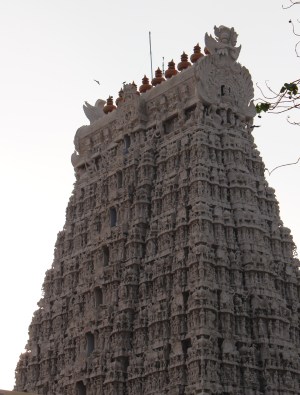
the temple Tiruchendur


The Name – Thoothukudi


Originally denominated as ‘Thirumandhira Nagar’, the name of this city was transformed to Tuticorin by the Portuguese who could not pronounce the actual name. Tuticorin is called ‘Thoothukudi’ in Tamil. This term finds its origin from two Tamil words, Thoothu and Kudi. Thoothu means to dig and Kudi means to drink. As this interurban doesn’t have rivers, the people living there have to dig wells and fetch their drinking water. As the other interpretation goes, Thoortha means ‘the land recovered from the sea’ and Kudi stands for a colony or a human settlement. So, the combination of these two terms means a colony that is established on the land which is recovered from the sea. http://www.indiahotels.com/tuticorin/362-tuticorin-tourism


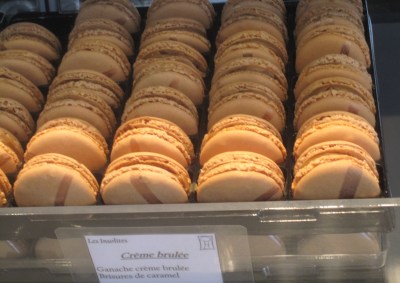
thoothukudi macaroons made of cashews, egg whites and sugar!
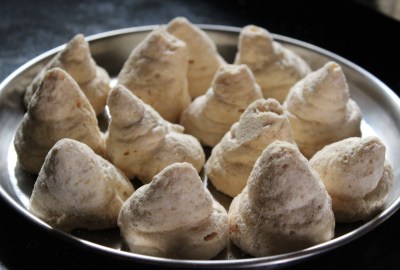
 

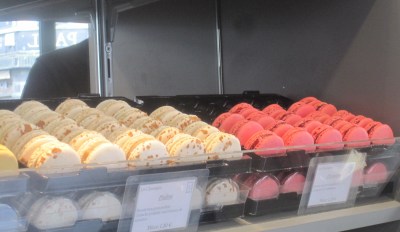
and the french macarons
 

and the various options
 

This is the city where I started my early schooling, later after we shifted to Mainland Madras aka Chennai, Thoothukudi was our most favourite holiday destination. The reason was purely, solely one… Thaatha Veedu- grandfather’s house.

Nostalgia! I truly relish!

As kids, we would wait for the last day of the school academic year. Not to just enjoy the start of the vacation, but to catch the train on the same evening to ‘thaatha veedu.’ Wasting even a day in Chennai was not accepted!

Today, when the train crossed Madurai, started my count of speciality foodies and goodies, exclusive to those towns.


  • Madurai Malli – jasmine flowers and idlies (rice cakes) as soft and white as jasmine;
  • Kadambur poli -sweet rotis;
  • Maniyaachi  murukku – savory;
  • Kovilpatti kadalai mittaai  – groundnut chikki and inji maraappa – sweetened ginger cubes;


Not in the train route, but closer to Thoothukudi,

  • Srivilliputhur paalkova – sweet milk khoya;

and the very special –

  • Tirunelveli halwa – sweet made of wheat flour and lots of nei – clarified butter;

and many more I have missed..


Special Features


The salient features of the district include its lengthy,curvy and scenic sea coast which was an international cynosure in the days of yore for its pearl fishery; beautiful coastel villages with their sacred temples, churches and mosques like Tiruchendur, Manappadu and Kayalpattinam respectively, Adhichanallur, one of the cradles of the ancient civilizations, Korkai, an ancient port of the Sangam Pandyas,Kayal, the confluence of the river Tamiraparani with the Bay of Bengal,one of the five illustrious rivers of Tamilnadu,

Panchalamkurichi, the capital of Veerapandiya Kattabomman, an early martyr, for the cause of freedom,

Ettayapuram, the birth place of the great poet Subramanya Bharathi,

Ottapidaram the home town of V.O.Chidambaram Pillai,who dared to sail ships as a measure to combat British imperialism;

Maniyachi, where Vanchinathan assassinated Ashe, the British Collector for this high –handedness against the leaders during Swadeshi Movement;

Great missionaries like G.U.Pope, Veeramamunivar, Caldwell and others who, besides their missionary work,contributed a lot for the development of Tamil language and literature and above all the enterprising and hard working people who now constitute a major trading community in the State. http://www.thoothukudi.tn.nic.in/profile.html


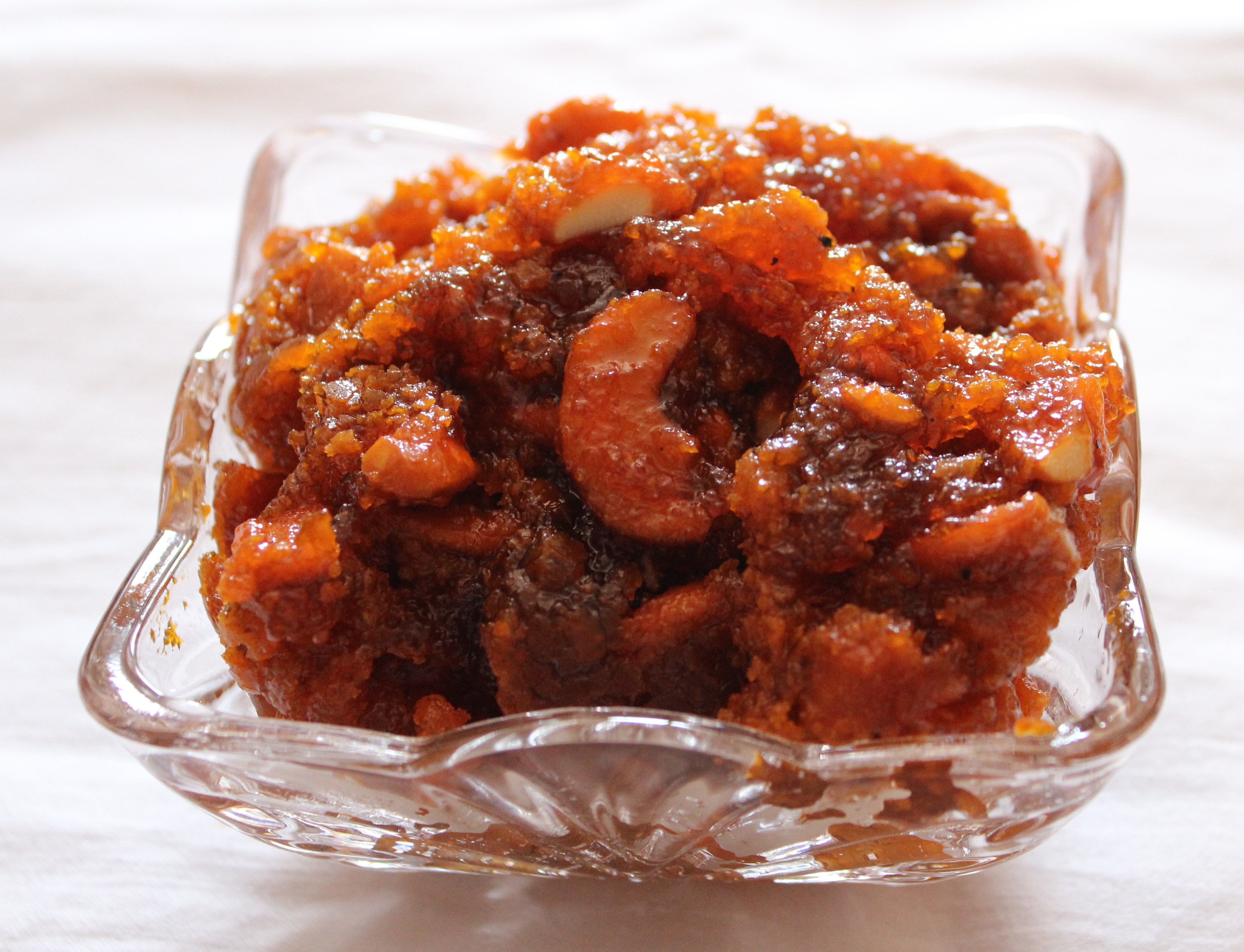
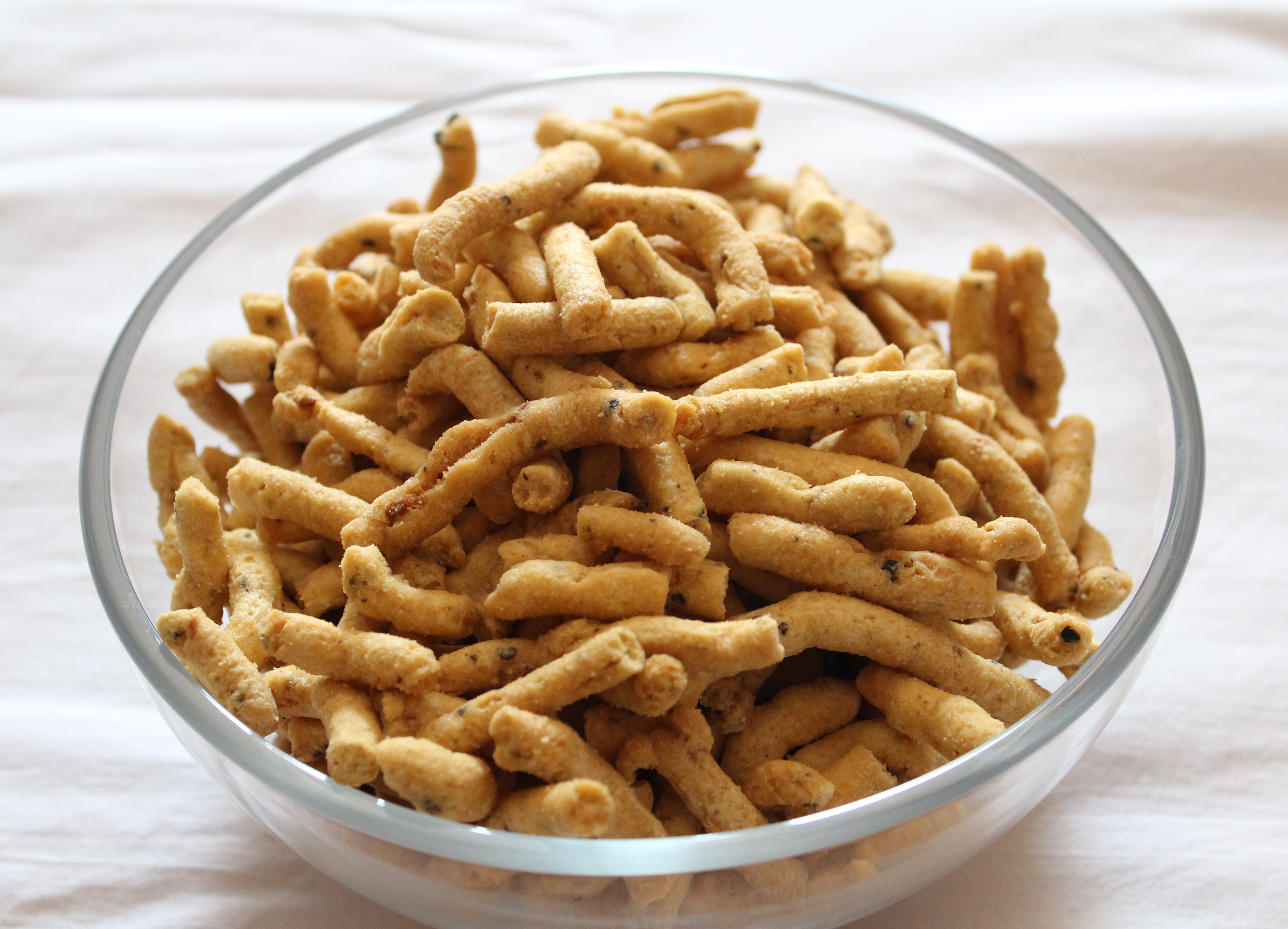
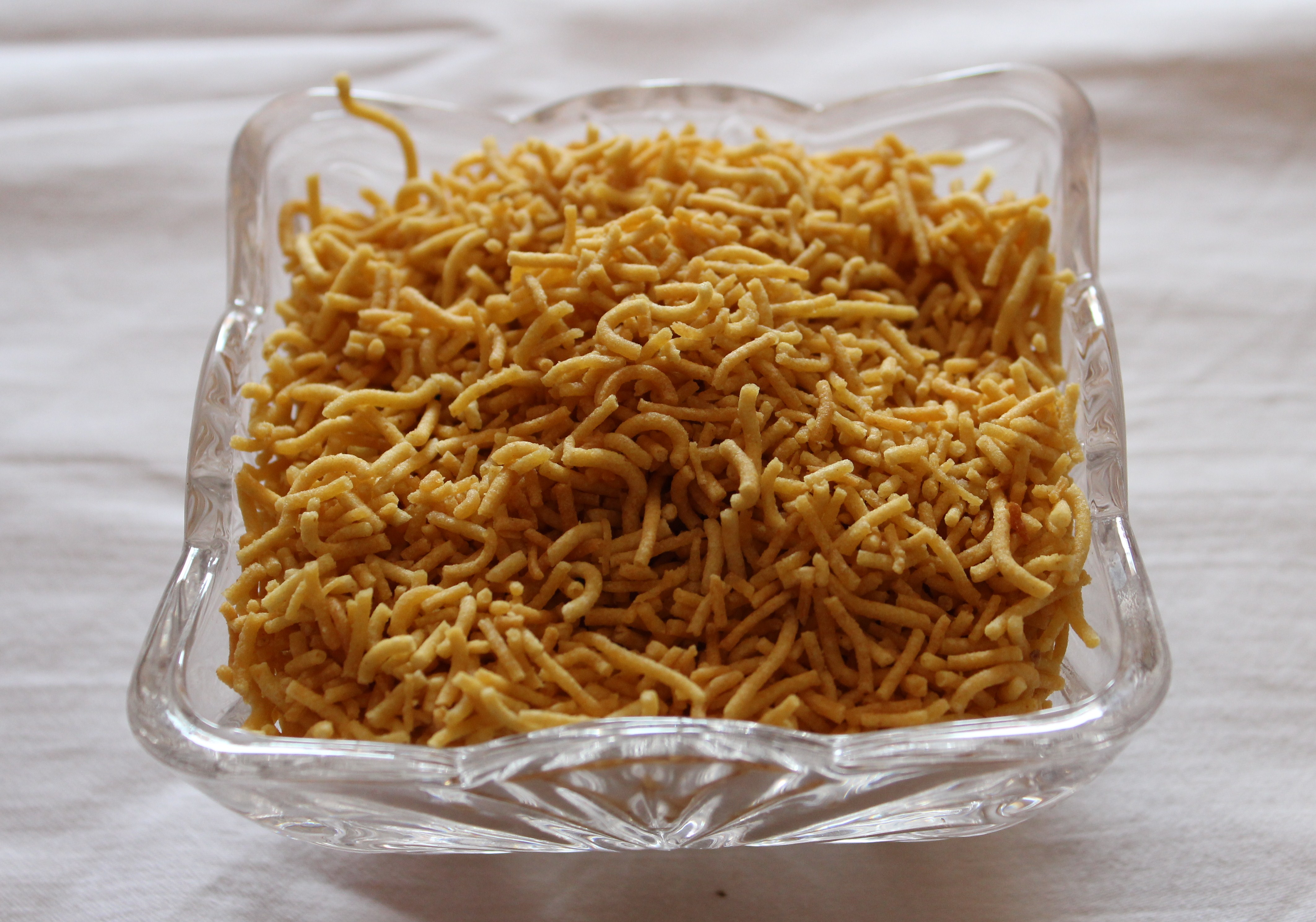
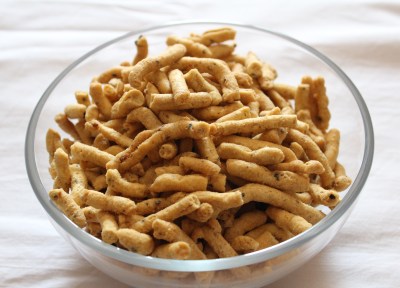
Coming to the goodies corner, Thoothukudi is known for its exclusive sweets – Macaroons, Mundhiri Halwa – Cashewnut Halwa; savouries like Omapodi, Karasevu, Mixture; and those very special bakery products – Plum Cake and various other biscuits!


mundhiri halwa


My memory seems to drive me backwards.. At least some twenty years back!

There we arrive in Thoothukudi,  to meet all of nearly ten cousins, nine aunts, minimum of four  uncles and aachi and thatha (grand mother and grand father).   The palatial house is filled with laughter and giggle, chit chats and continuous cooking, eating and munching special goodies like halwa, macaroons, mixture, omapodi, Kara sevu and many more specialities of Thoothukudi.

The day starts with fresh milk milked from our own thatha veetu maadu .. Cows that belong to grandpa’s house! On Grandpa’s own cows read – https://dosaikal.com/2012/06/18/the-dutch-dairy/.

Ground floor, in the kitchen, all the ladies are cooking for almost thirty people per meal, amidst laughter and crazy gossips; we the youngsters climb up the stairs for some secret teenage talk…

Upstairs is a long house, in which some of the rooms are meant to store raw mangoes and guavas. The mangoes are kept in thick patches of straw to ripen faster.

The chat session starts after breakfast, then it continues with the search of ripe mangoes… as a munchy snack! We bend down to search for some ripe mangoes… Successfully pick a few.

Then it is time to wash, squeeze well with hands and make a hole on top and voala! Mangoes are ready. We enjoy those juicy, fruity, tasty mangoes (never count how many). We chat again till lunch…

There is a call from downstairs. We are asked to bring some (more) ripe mangoes for Thayir saadham (https://dosaikal.com/2011/12/22/thayir-saadham-mor-milagaicurd-rice-sun-dried-chillies/) or as lunch dessert… The search is on again in the big room. We pick the mangoes and proceed downstairs for lunch.

The same search holds good for guavas too! A few of us who would like guavas raw and the few others like me who would prefer ripe… The same straw patch – same search – same enthusiasm.. the fruits are different.

We were young enough for the search.. young enough for the munch and young enough for the non-stop munch to digest too!


kara sevu


I am brought back to reality, not by the train that stopped at Thoothukudi station, but by the voice of vendors in Kovilpatti Station,  who sell Kadalai Mittaai and Inji Maraappa, which is exclusive to Indian trains.

A short travel and we reached Thoothukudi. We entered Thatha Veedu – Grandpa’s House! I become a kid whenever I step into that house where i spent most of my vacation time as a little girl.


omapodi


A trip to Tirunelveli, place of my paternal grandparents and Tiruchendur – the famous Hindu Shore Temple of Lord Murugan used to always be part of the holiday agenda.

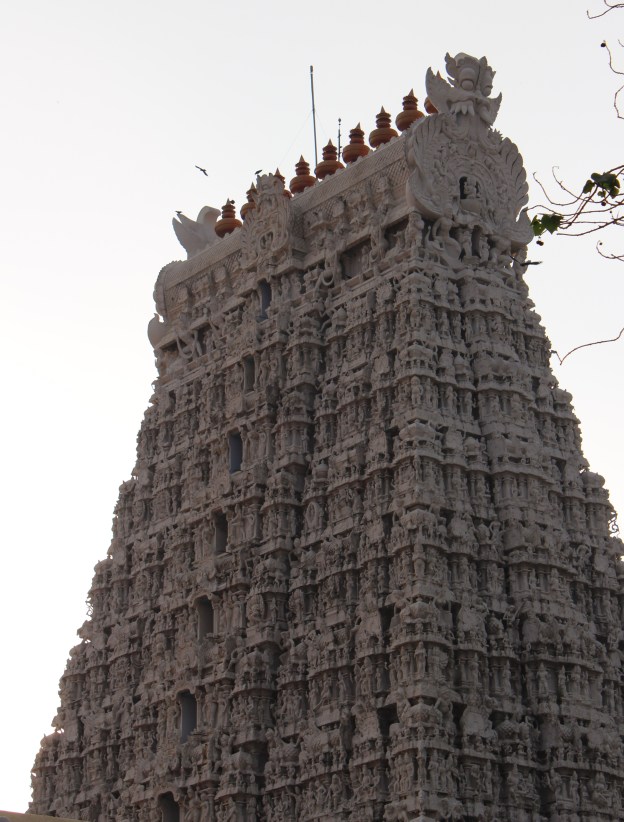
I did not want to miss that this time too.  We visited Tiruchendhur –  the sacred Temple of the Tamil God Murugan-

where he defeated the demon Sooran…

Where Kanda Sashti is celebrated at its best… (https://dosaikal.com/2011/10/31/paanakam-the-energy-drink-of-south-india/);


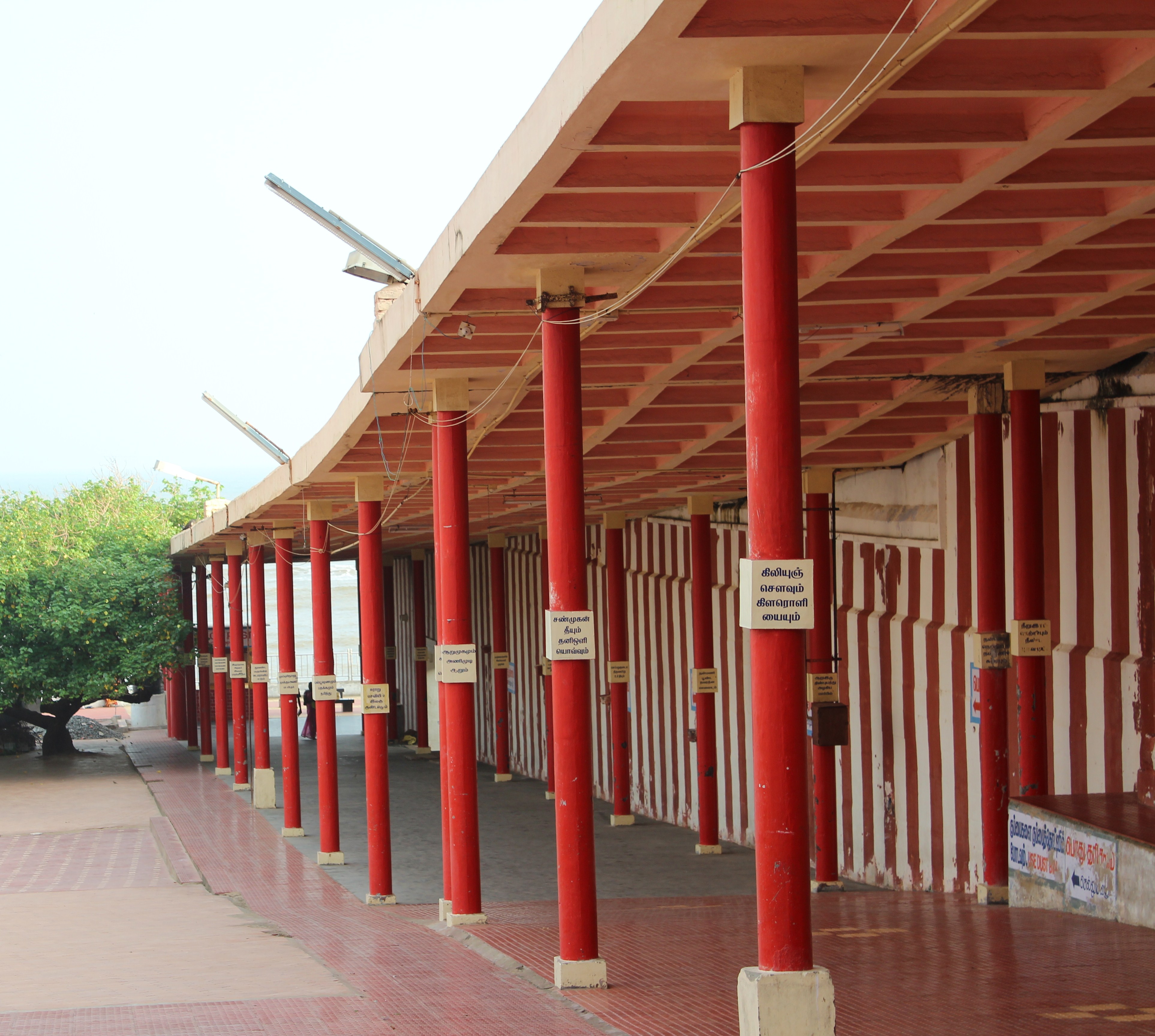
the temple premises


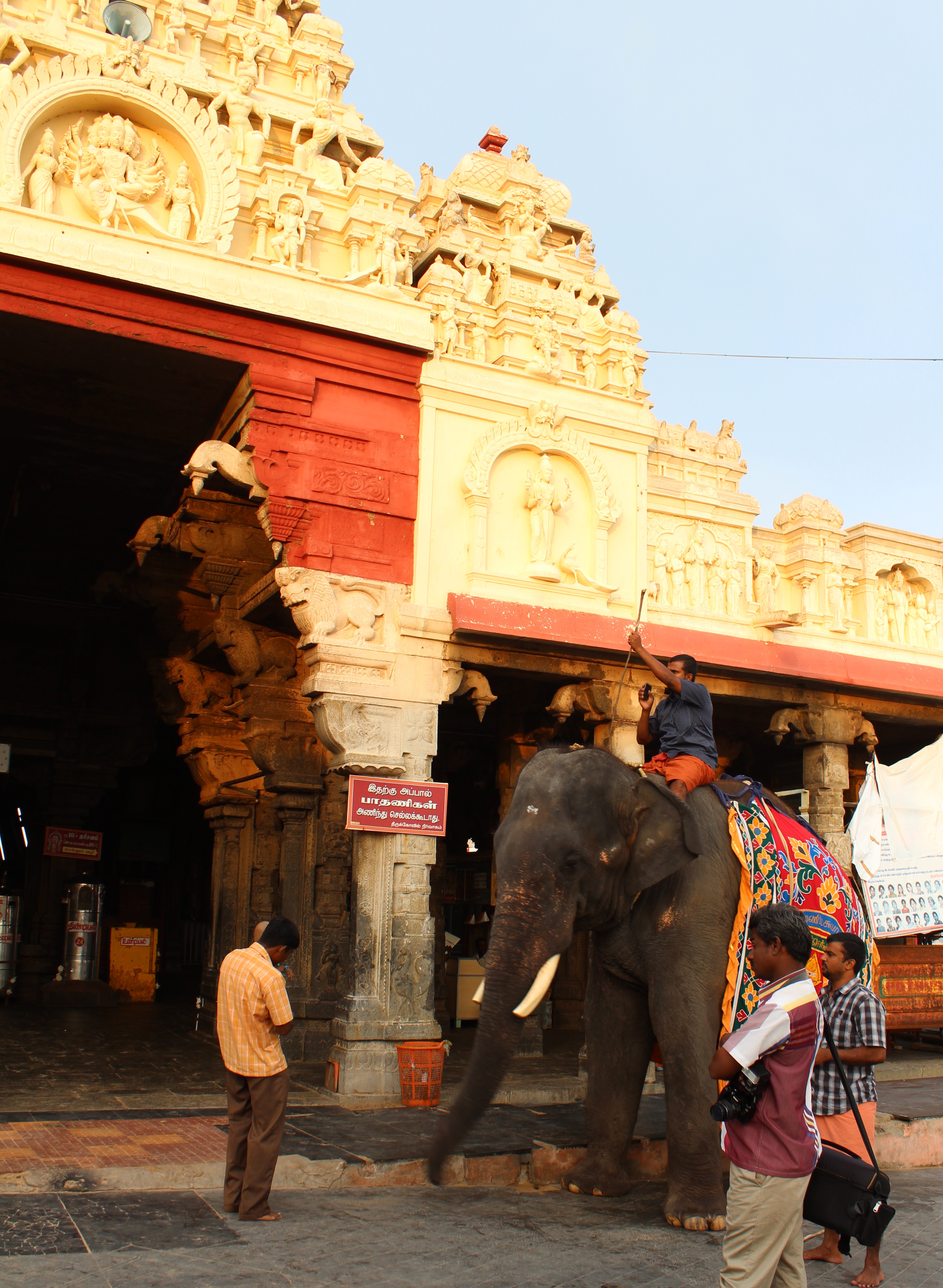
and the trademark elephant


Thiruchendur is one of the very few places one can get ‘cheppu chaamaan’ – wooden toys for kids…  Easy to play, less hazardous than plastic, has authentic south indian household utensils, wrapped in exclusive palm leaf baskets.

I was disappointed to find the cheppu chaamaan – wooden toys packed in plastic bags;

Another disappointment was that the number of utensils had drastically reduced.

But, thankfully the traditional puja basket, which has the offerings to Lord Murugan came in the same panai olai petti – palm basket!!

traditional puja basket


Got a wonderful dharshan at the temple and returned back to Thoothukudi. Got to the train station with innumerable thoughts and nostalgic emotions… And got to the next destination to meet more near and dear ones!

Our travel continues…
Good Bye Holland!

Good Bye Holland!

So… now, it is bye bye time.

Saying bye to near and dear ones is never easy…

Shifting one’s home can be tremendously pain staking, loaded with the stress of packing things right and holding emotions tight.

I start writing this post from New Delhi Airport Lounge where we wait to board the flight.

The last few weeks have been very busy, not able to communicate with friends through dosaikal and telephone too. So busy that recording emotions and memories of holland in words also did not work out well.

Navratri passed by – no recipes on sundals!
Many special occasions to share and many more new trials on cooking went on and on but no recipes added!
A special post on Wassenaar- the elite city that we live(d) in for more than three years was planned – could not materialize..


Such is the physical and mental pressure one undergoes … or have I been too packocentric(!?)
Even when I first boarded the flight from Amsterdam, the physical pressure of working almost sleepless for nearly a week and planning and completion of important tasks that started nearly a month ago, overtook the reality of leaving a country.


Now, I sit in the Airport in India,  with the feel of really having shifted, presently homeless, yet to settle in a new place, might be after a month’s break!


Holland has been a wonderful country to live in!

dutch houses


A wonderful country why? A few of them –


a. The beautiful dutch houses;

b. A definite distinction between footpath, cycle path and the motor path that makes commutation so systematic;

c.  When one walks on the foot path of the city, whoever comes across, known or unknown would wish a good morgan (good morning) with a friendly smile;

d. Be it the super market or any shop, anyone would start with Dutch, the language of the country, but…. when one mentions that he or she does not know the language, the person would immediately shift to English;

e. Most of them who immediately shift to English would be well versed in many of the European languages;

f. If the forecast says it is a sunny day, they immediately plan to enjoy in the beach or any nearest destination to spend with family and friends;

g. Different kinds of multi geared bicycles and the passion not only to ride it but take to their holiday destination too;


h. The fascinating caravan – the different kinds of caravans one sees on the road in and around the country and around Europe;

i. The different varieties of milk, cheese, yoghurt and various other milk products;

j. The Dutch Blue Pottery;

k. The exclusive flowers in different seasons;

l. Sinterklaas and tulips;

m. The windmills and wind and especially the sky ever ready to rain


the list would go on and on – but…

We have been mesmerised by the Dutch Water Management Skill. They say


“God created Earth and the Dutch created Holland”.

Certainly, this phrase is true. The Dutch have reclaimed many of their cities and towns and they are the world leaders in Land Reclamation!


Today, approximately 27 percent of the Netherlands is actually below sea level. This area is home to over 60 percent of the country’s population of 15.8 million people. The Netherlands, which is approximately the size of the U.S. states Connecticut and Massachusetts combined, has an approximate average elevation of 11 meters (36 feet). The Netherlands ties Lemmefjord, Denmark for claim to the lowest point in Western Europe – Prince Alexander Polder lies at 23 feet (7 meters) below sea level. http://geography.about.com/od/specificplacesofinterest/a/dykes.htm


Afsluitdijk


The Dutch and their struggle against the sea has made them the true conquerors of their Land from Sea! Actually, there needs to be a special post on the Delta Works and Afsluitdijk – both considered to be one of the seven wonders of the modern world. For more details see – http://www.unmuseum.org/7wonders/zunderzee.htm


The Afsluitdijk is a 32kilometer long dike, which connects the province of North Holland with the province of Friesland. It was constructed between 1927 and 1933 as a fundamental part in a larger plan called the Zuiderzee Works. With the completion of the Afsluitdijk the Zuiderzee (‘Southern Sea’) became the fresh water lake of IJsselmeer. http://www.holland.com/global/tourism/Article/afsluitdijk-10.htm


I shall not stop my Dutch Diary until I have shared my captivated memories on Holland!


So, here I am, ready for the relentless travel that is in front of me… Visiting family  and friends in the south of India, learning more authentic dishes from amma and aachi and not to mention the big and small list of shopping for the new place!


For now, it is bye bye Holland and bye bye friends… Thankyou for all those sweet memories and wonderful moments that made our life in this beautiful country a marvellous and an incredible journey to cherish.
 

Meet you all with my new post from India!

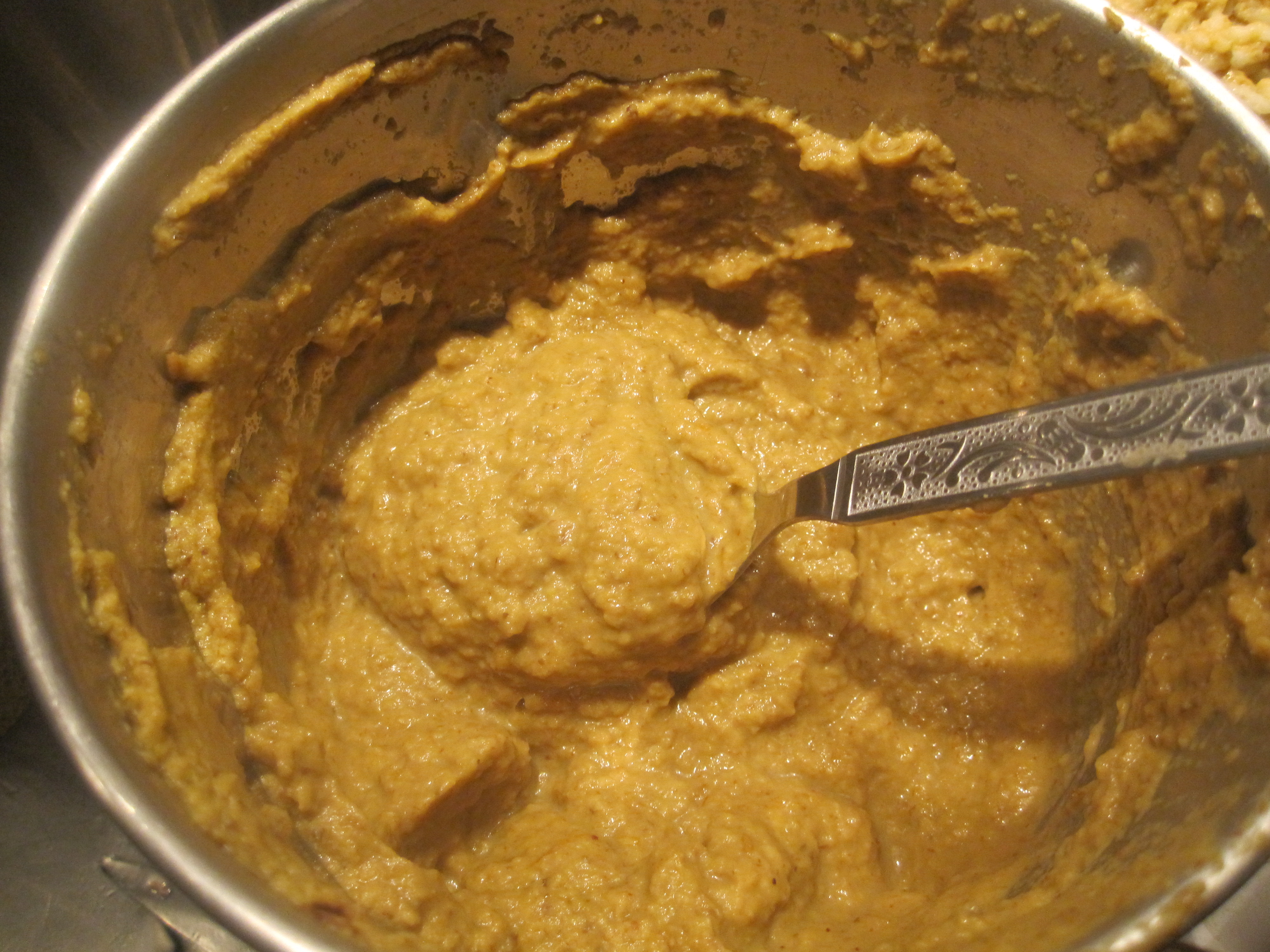
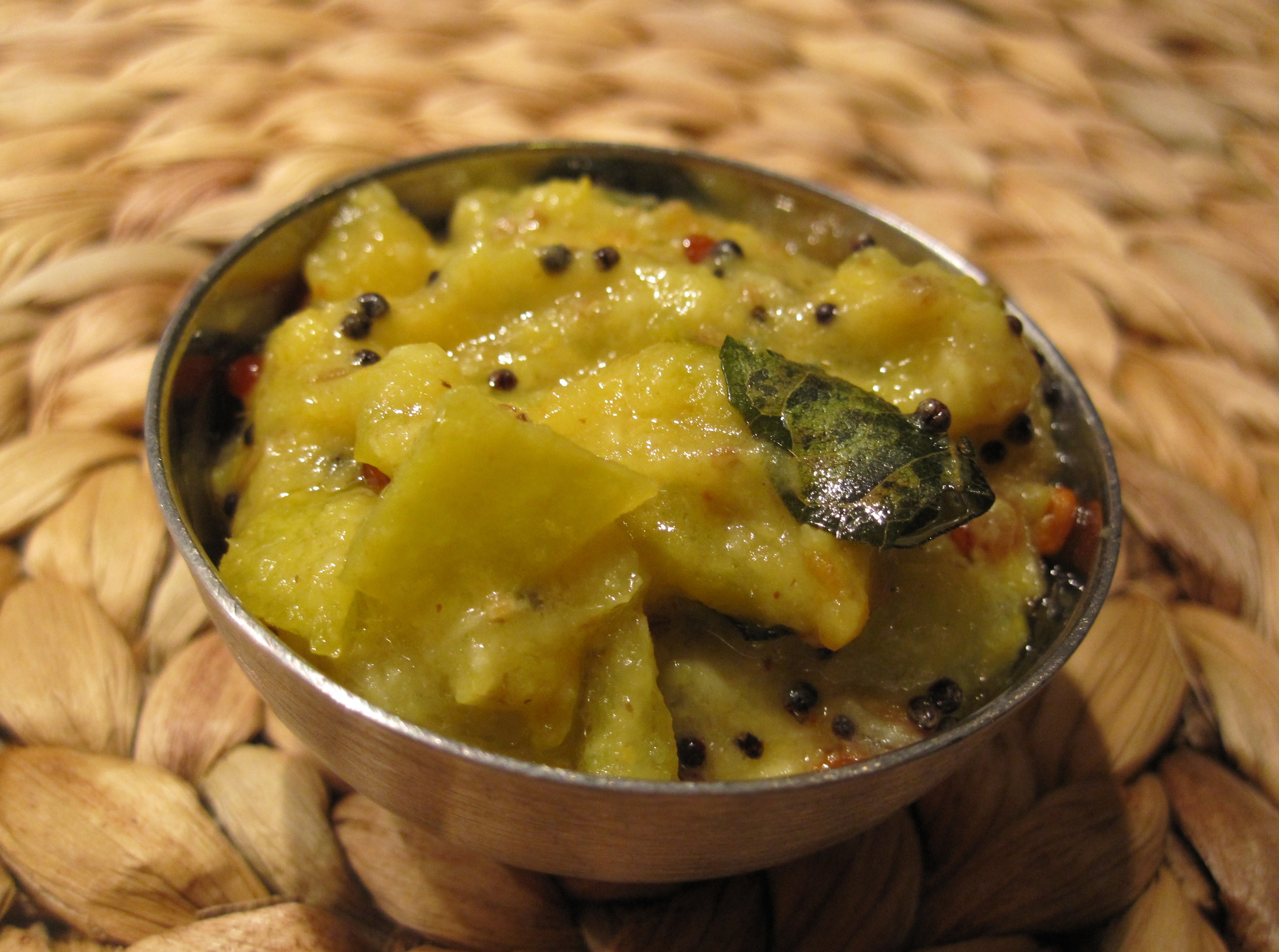
Kathirikkai Thuvayal/Brinjal Chutney


rice with brinjal chutney

Now, here comes a special recipe. Why special?

Because… this one belongs to one my friends’ grandmother. While dosaikal.com talks about some of the traditional recipes I learnt peeping into my grandma’s kitchen, and ofcourse also trying my hands at cooking with mama and grandmama – amma and aachi, I feel delighted to try some of those precious recipes that the elders of your household have left behind for you!

Thank you so much ‘A’ for sharing this, from your treasured cookbook – your grandmother’s recipe.

Kathirikkai is Eggplant to Americans and Brinjal to the British, if I am right.

It is supposed to possess many medicinal properties and is used as a remedy for cancer, hypertension and diabetes. Brinjal is high in water content and potassium. This is an excellent cholesterol regulator. Speaking of heart health, eggplant is also naturally low in saturated fat, cholesterol and sodium.http://www.health-galaxy.com/Benefits-of-brinjal.html

A very simple and easy recipe. ‘A’ also informed me that hot rice and thuvayal is incomplete without a kootu to go with it. Kootu is a stew of vegetables. Mixing the thuvayal/chutney with rice would make it a thick mix and the stewy kootu would aid in bringing in a balanced consistency during the travel of the food towards digestion. Kootu which is cooked with lentil also helps in the protein intake in a meal. Shall try to post ‘kootu’ in the near future.


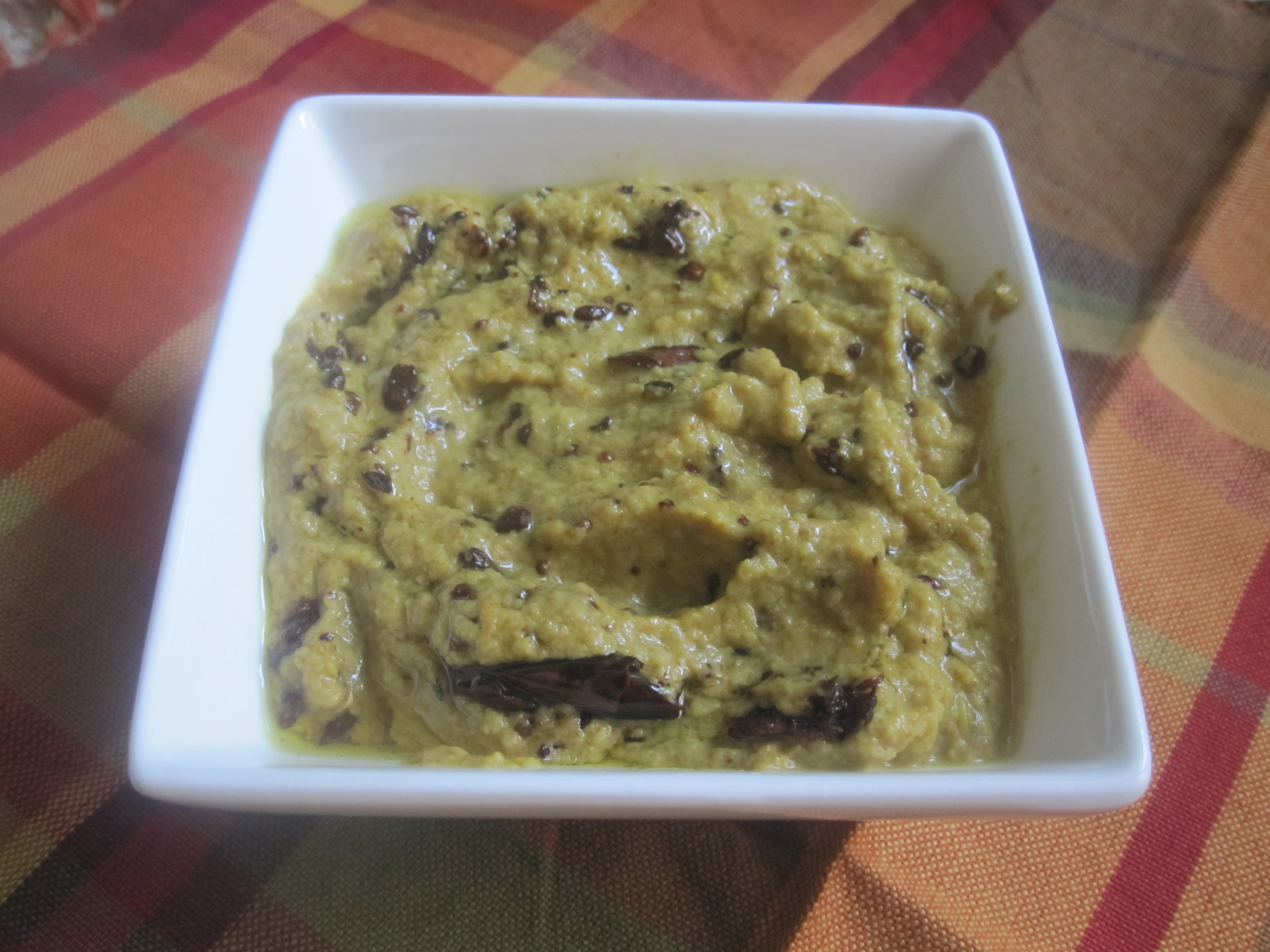
Kathirikkai Thuvayal/Brinjal Chutney

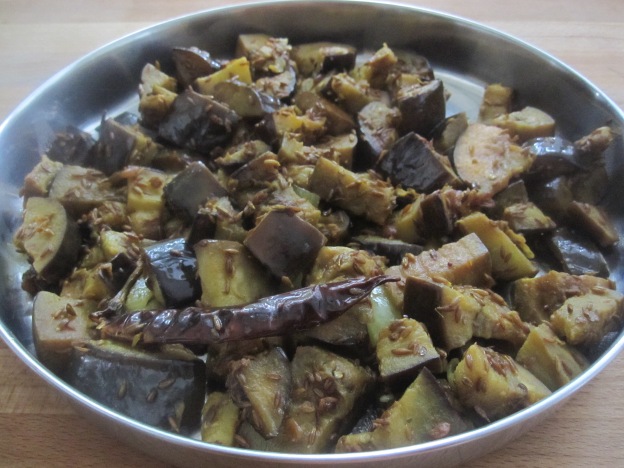
kathirikkai thuvayal

Ingredients (serves approximately 6)

  • kathirikkai/Brinjals – 3 no.s if medium sized (I used one long brinjal)
  • oil – 3 tblsp
  • kadugu/mustard seeds – 1 tsp
  • seeragam/cumin seeds – 1 tsp
  • perungayam/asafoetida powder – 1 tsp
  • manjal podi/turmeric powder – 1/2 tsp
  • red chilli powder – 1 tsp
  • kariveppilai/curry leaves – a few
  • puli/tamarind – about 25 gms soaked in 1/2 cup warm water

kathirikkai

cut brinjal in water


Thaalippu/Seasoning

  • oil (preferably gingelly oil) – 1 tsp
  • mustard seeds – 1/2 tsp
  • red chillies – 1 long chilli split to halves

left to cool in a plate

smooth paste in blender

Method of Preparation

  • Clean brinjals and cut to small pieces
  • Always keep cut brinjals in water to avoid discoloration
  • Soak tamarind in warm water and leave aside
  • Heat oil in pan. Add mustard seeds, cumin seeds, curry leaves and saute for a while
  • Now add asafoetida powder, turmeric powder, red chilli powder (I used 1 long red chilli in place of powder)
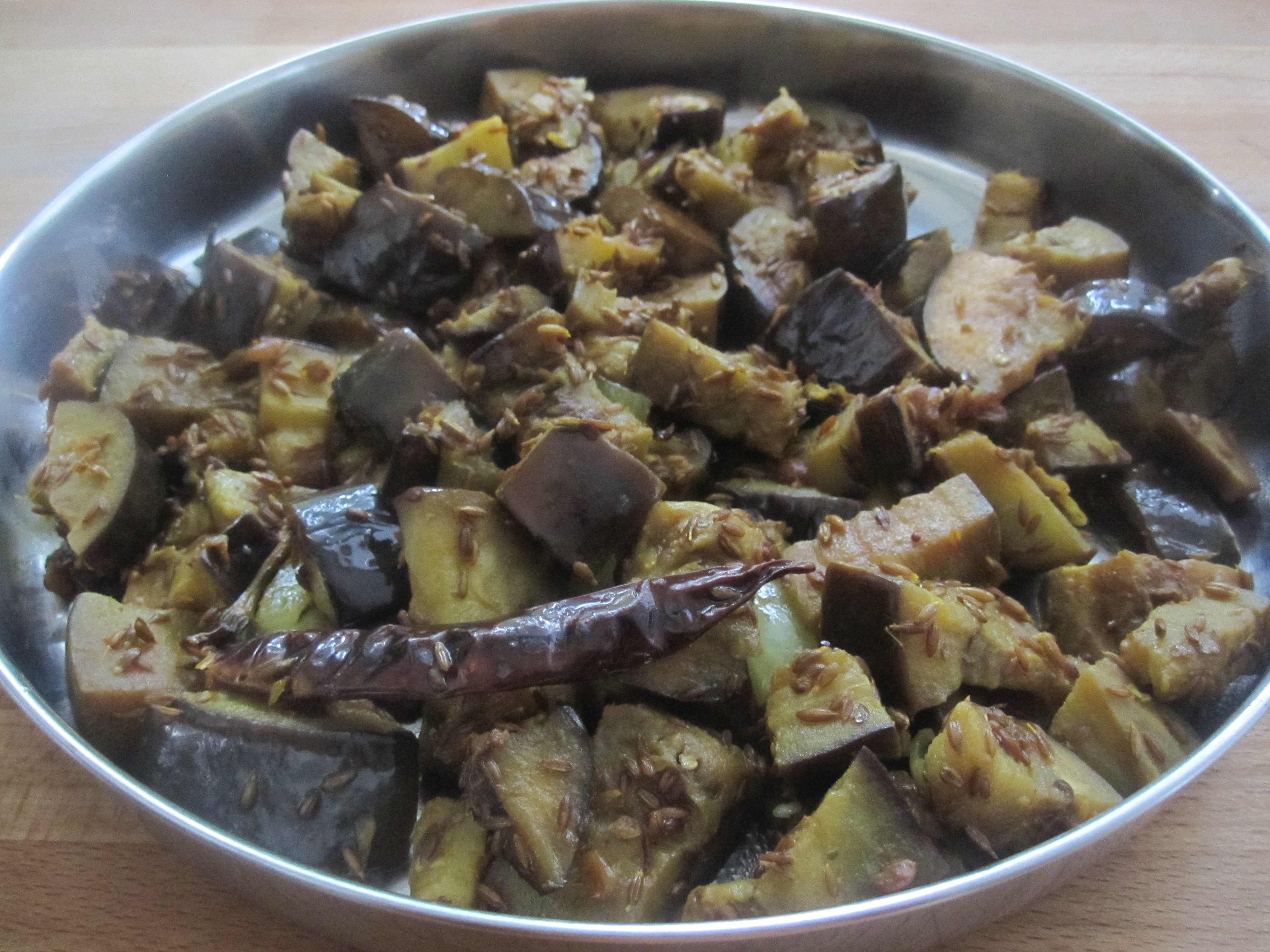
  • Mix the cut brinjals and fry them till soft
  • When the brinjals are soft, transfer to a plate or bowl and cool the ingredients
  • After brinjal is cooled, add the tamarind with water and grind in a blender to a smooth paste
  • For the thaalippu/seasoning, take 1 tsp in a pan – add mustard seeds – when they splutter, add red chillies – when they turn a bit darker pour into the thuvayal/chutney
  • Thuvayal/Chutney is ready
  • Serve with hot rice and kootu or just enjoy hot rice and chutney.

kootu – lentil and vegetable