Vengaya Chutney/Onion Chutney

This is a very simple chutney to go with all kinds of lentil based dosais. By lentil based dosais, I mean those with more proportion of lentils to rice. The basic dosai has rice and dehusked black gram in the ratio 4:1 – 4 cups of parboiled rice and 1 cup of dehusked black gram. Lentil Dosais would have more quantity of lentils to rice. (eg. Whole lentil dosa and many more to come). These chutneys are also good for basic dosais, no doubt.


Ingredients

  • vengayam/onions – big -3 nos
  • thakkali/tomatoes – big – 2 nos
  • poondu/garlic – 6 cloves
  • milagai vatral/dried red chillies – 3 nos
  • salt – to taste
  • oil – 1 tsp

Thaalippu – Tadka

  • oil – 1 tsp
  • mustard seeds – 1 tsp
  • broken urad dal – 1 tsp
  • curry leaves – a few

Method of preparation

  1. Take 1 tsp oil in a chatti/deep pan
  2. When oil is hot, add garlic cloves and fry till golden
  3. Add onions and saute for 2 minutes
  4. Add tomatoes and dried red chilles and fry till tomatoes becomes soft
  5. Simmer stove accordingly. Due to less usage of oil, there are chances of onions getting burnt if stove is kept on high flame
  6. When tomatoes are soft enough to be mashed with a spoon, turn off the stove
  7. Let it cool
  8. Add salt and grind it well in mixer grinder or blender till smooth
  9. For tadka, heat oil in a small pan
  10. Add mustard seeds
  11. Let mustard seeds splutter, add urad dal
  12. When urad dal becomes light reddish, add curry leaves
  13. Pour this into the chutney
  14. Red chillies can be adjusted according to required spice of the family
Payaru Dosai/Whole lentil Dosai/Dosa

This is a dosai/dosa with the goodness of many kinds of lentils in it. Lentils are a rich source of protein. They also contain dietary fiber, folate, B vitamins, minerals and are also a good source of iron. Generally, paruppu/dhal or sundal/cooked lentil snacks can be made of pachai payaru/whole green gram and karuppu kondaikadalai/black chickpea. Muzhu ulundhu/whole black gram is used in dhal makhni in north indian cuisine and some specialities like ulundhankali/black gram halwa (recipe would follow later) in tamilnadu cuisine.

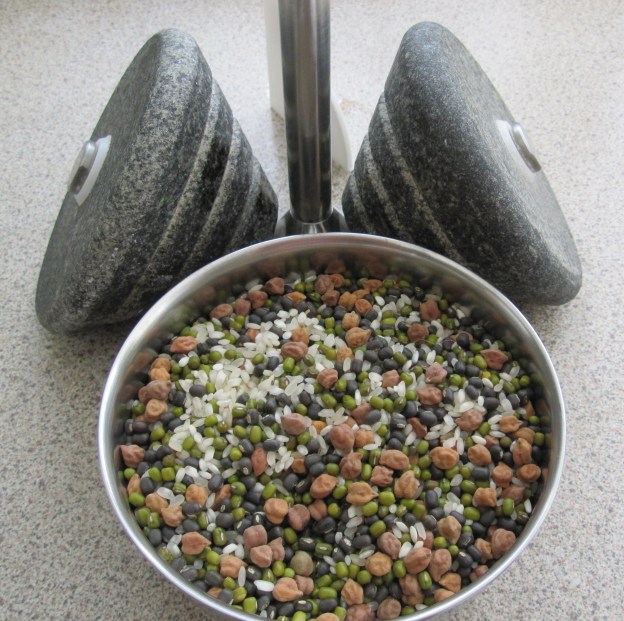
This dosai combines whole green gram, whole black gram and black chick peas with both raw rice and par boiled rice.


Ingredients

  • pachai payaru/whole green gram – 100 gms
  • muzhu ulundhu/whole black gram – 100 gms
  • karuppu kondaikkadalai/black chick peas – 100 gms
  • pacharisi/raw rice – 50 gms
  • puzhungal arisi/parboiled rice – 50gms
  • vendhayam/fenugreek seeds – 1 tsp
  • red chillies – 4 nos.
  • salt – 1 tsp

Method of preparation

  1. Take all the lentils and rice together in a wide vessel and wash well
  2. Soak the washed rice and lentil in nearly double quantity of water
  3. Add fenugreek seeds
  4. Cover with loose lid and let it soak for 8 hours
  5. In a wet grinder or blender, with 4 red chillies grind the above ingredients to a smooth paste
  6. Number of red chillies can be adjusted according to each household
  7. Add salt to the ground batter
  8. Dosais can be made immediately
  9. Alternatively, the lentils and rice can be soaked overnight and ground in the morning and dosais are ready for breakfast immediately

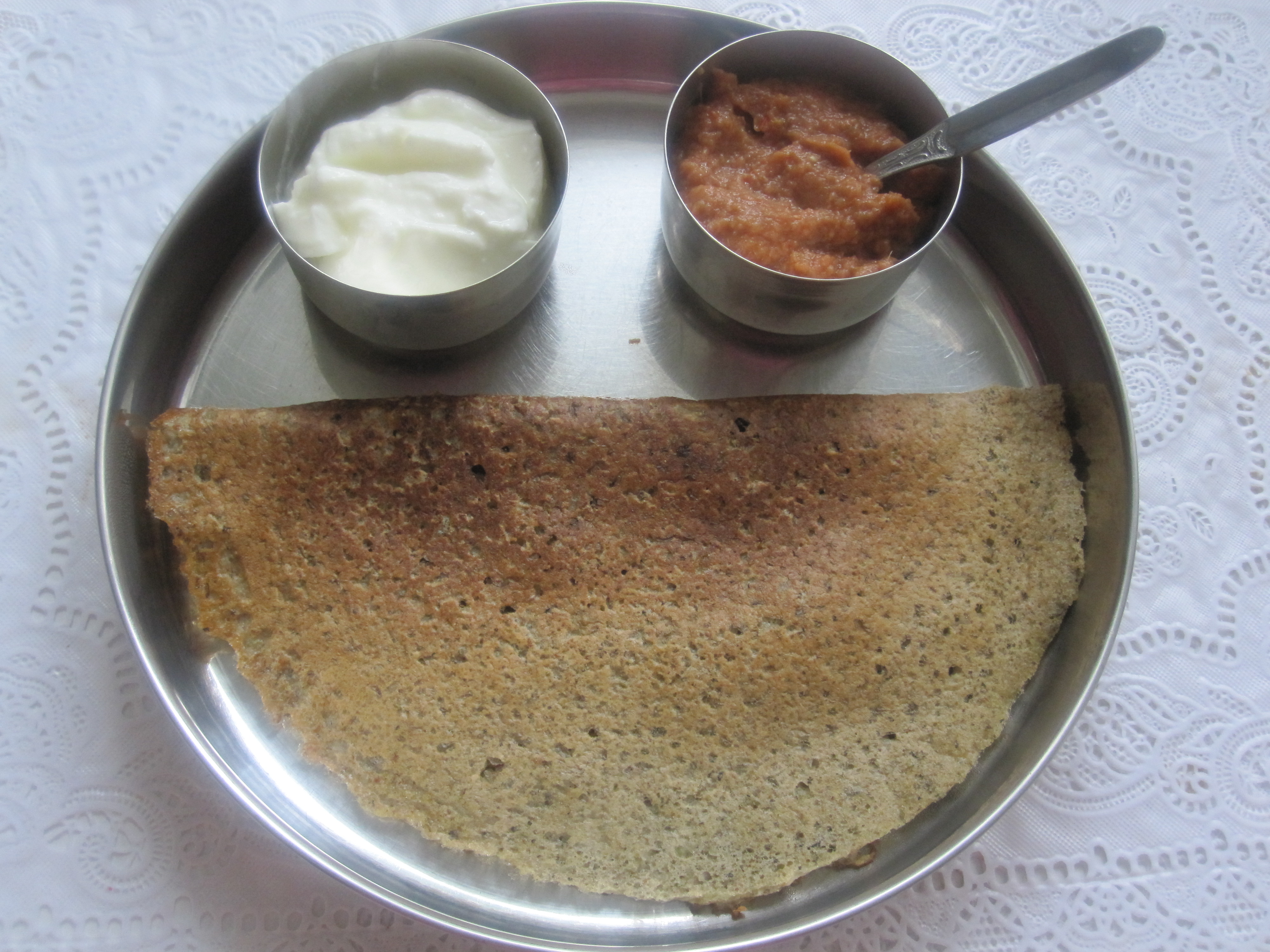
whole lentil dosai with onion chutnie, yoghurt and filter coffee

TIPS

  1. Beware: the batter tends to become sour and unfit for making dosais if not stored in fridge immediately
  2. The above mentioned quantity would make approximately 12 dosais
  3. Lentils may cause bloating, gas and heart burns. Hence, garlic could be added to the chutnie  to be had with the dosais
  4. Any spicy, red chilly chutnie would go well with this dosai
  5. With the red chutnie, a bowl of yoghurt could also aid in tackling the spice
  6. I always make the vengaya (onion) chutnie for this (please see chutnie category)
  7. Nothing can beat a hot cup of filter coffee to end it all.

Plain Dosai/Dosa

 Dosais/Dosas or Pancakes

Dosais/Dosas can be called the south indian pancake. The staple food of the tamils has been rice and other grains. In Tamilnadu, idlis and dosais – the blend of parboiled rice and dehusked black gram – are taken for breakfast and dinner with several varieties of chutneys to go with it.

These dosais are made soft and fluffy as a day-to-day affair. Elders at home prefer it this way as it is easier for their teeth. The children like them crispy. The elders have  the dosais with gingellyoil, where mothers prefer to give the kids with lots of ghee or clarified butter. Gingelly oil is another name to sesame oil. Wikipedia mentions that chinese, japanese and koreans use it as a flavour enhancer. In the south of india, gingelly oil is a cooking medium by itself. It is also used as a raw mixture to chutneys and chutnie powders.

Dosais can also be made from other different kinds of grains. In this section, we shall see the different kinds of dosais.

Plain Dosai/Dosa

The ground batter is used as Idli for the first day. The second day, when the batter becomes more sour is fit for making dosais. But I make dosais out of the first day batter too. The fenugreek seeds in the batter brings out the colour of the dosais.

Ingredients

  • Idli/Dosai Batter – as per need

What brings out better dosais/dosas

  1. The best dosais come out of wet grinders which are the traditional stone grinders
  2. Nevertheless, good blenders could do a good job
  3. The quality of dosaikal or the tawa/pan is important 
  4. Cast iron pans give out very good dosais but nonstick pans are good with less oil consumption
  5. Well fermented batters bring out the best dosais 
  6. The consistency of batter – not too thick and not too watery to pour in the pan

Method of Preparation

  1. When the batter is well fermented, mix it well from the bottom with a ladle
  2. Adjust water – the batter should be medium thick pouring consistency
  3. Turn on the stove and keep the pan on it
  4. Heat up the pan
  5. Sprinkle some water on the pan
  6. Apply 1/2 tsp gingelly oil preferably or any cooking oil to the dosaikal/pan
  7. Rub the oil evenly on the dosaikal with a kitchen tissue
  8. Pour the dosai batter in the middle of the tawa and spread it evenly in circular motion
  9. Let the stove be in full position
  10. Sprinkle droplets of oil around the corners
  11. After the dosai turns a little brownish, simmer the stove and turn it to the other side
  12. In less than 30 seconds on the other side, dosai is ready
  13. Apply a bit of ghee or clarified butter on top and serve
  14. The first dosai may not be the best. After the tawa is well used to oil, dosais come out better. So, better not ask for the first!


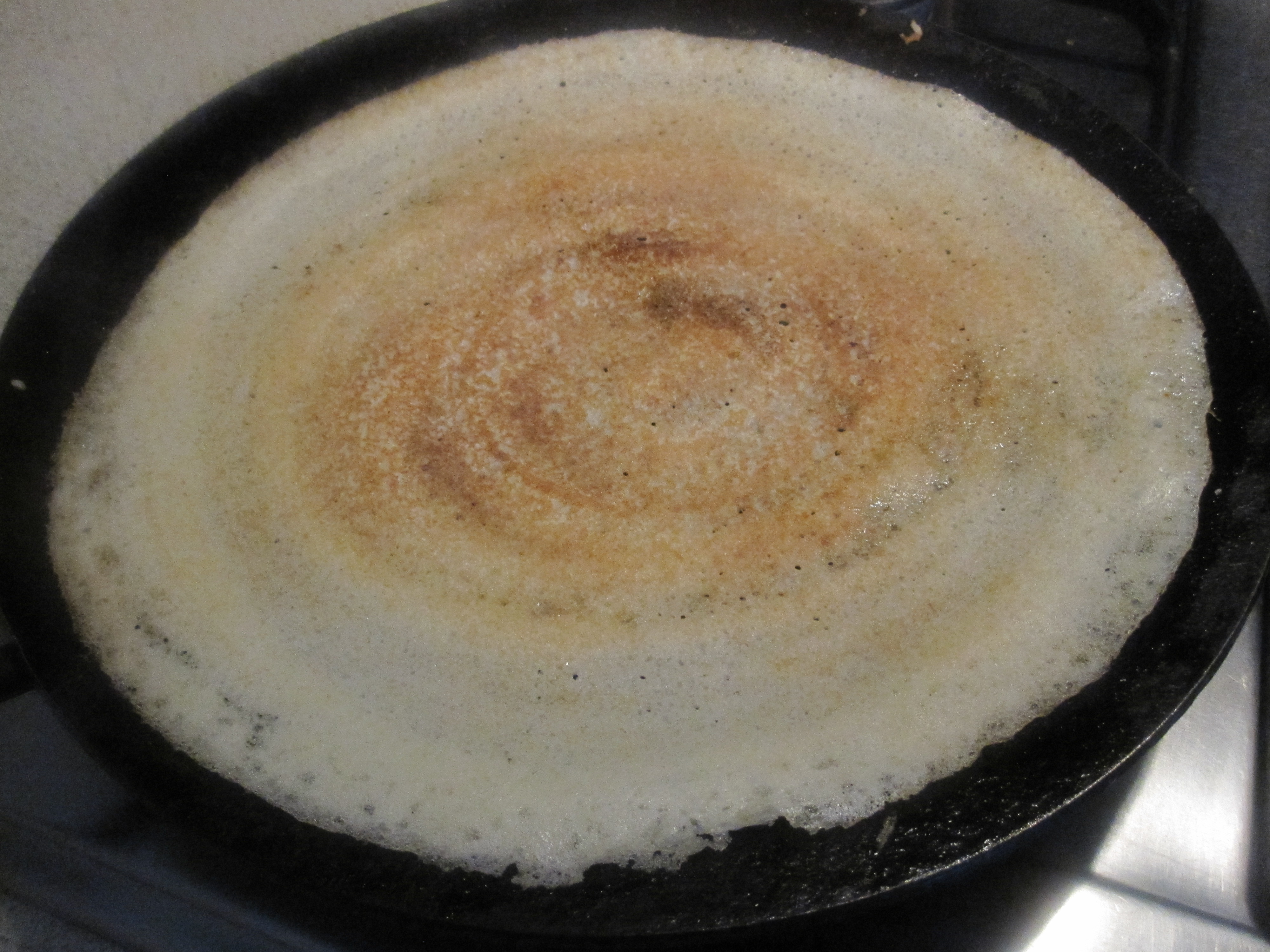
Dosai made in cast iron dosaikal/tawa, with oil spread around the corners


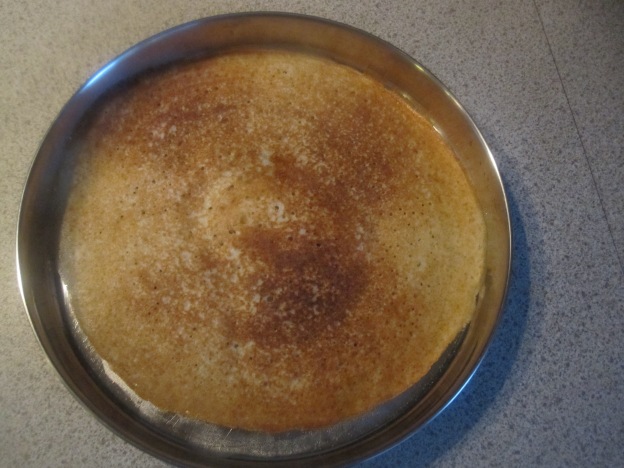
Turned on the other side – dosai is ready


 the third or fourth dosai is the best  


Serve the dosais with chutney (https://dosaikal.com/category/chutneys/), sambar or gun powder chutney.

Inji thuvayal – Ginger Chutney

Chutneys are an important part of tamilnadu cuisine. The staple food Idli – steamed rice cake and Dosai – Rice and lentil pancake is always had with different kinds of chutneys. These might vary in their combination of ingredients – coconut, dals and vegetables to make it more spicy, tangy or very spicy.

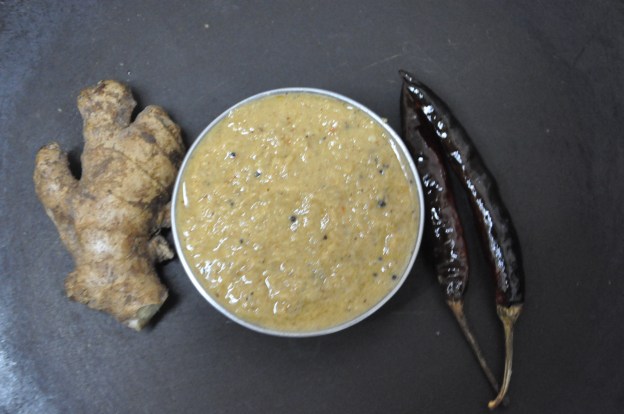
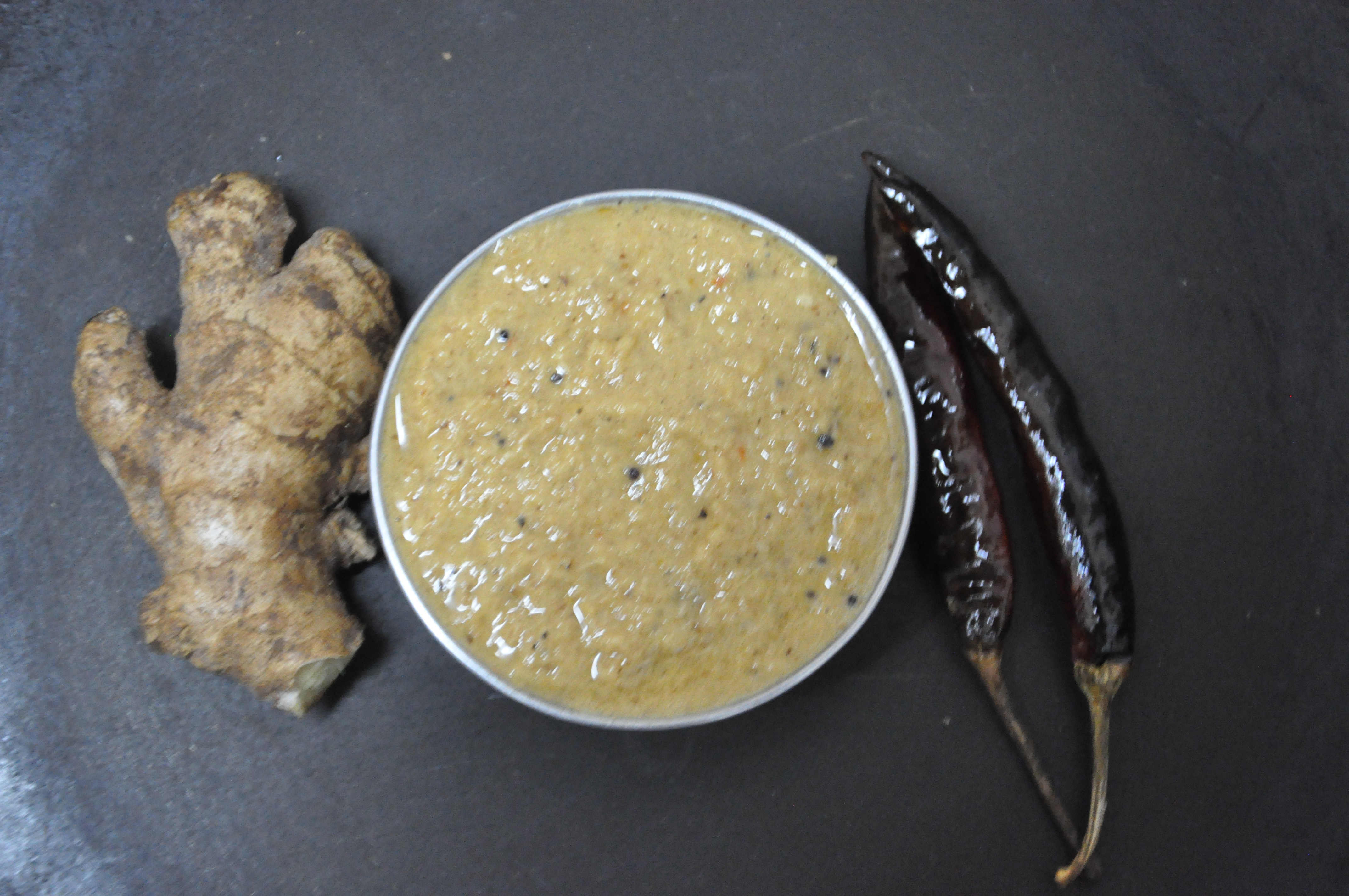
Inji thuvayal – Ginger Chutney

Inji Thuvayal is an accompaniment for kaaikari sodhi or the vegetable stew. This is mainly for digestional purpose since coconut milk makes the dish very heavy. Ginger aids in digestion.


Ingredients

  • Ginger – 5 tsp
  • red chillies – 3 nos
  • freshly grated coconut – 1/4 cup
  • tamarind – 1 small lemon sized
  • salt to taste
  • oil – 1 tsp for frying

Thaalippu – Tadka

  • oil – 1 tsp
  • mustard seeds – 1/2 tsp
  • broken urad dal – 1/2 tsp
  • curry leaves – a few

Method of preparation

  1. Heat 1 tsp oil in a pan
  2. Fry ginger and red chillies for a while
  3. Now add freshly grated coconut and tamarind and fry for a while
  4. Grind all the above together in a blender to a fine paste
  5. For tadka, heat oil in a small pan
  6. Add mustard seeds
  7. Let mustard seeds splutter, add urad dal
  8. When urad dal turns light reddish, add curry leaves
  9. Pour this into the chutney
  10. Serve with stew.

Vellai Kuruma – White Kuruma

Kurma or Korma is basically a gravy dish where vegetables or meat is cooked or braised in a  sauce with different combinations of spices to go with steamed rice or chappathi. It is made quite spicy and colourful with tomatoes, garam masala and ground coconut paste in tamilnadu. For main courses like Idiyappam or Aappam, chicken or mutton kurma are considered the best combination. I named this white kurma because this was quite different from other kurmas which are red or orange in colour.

When we visited Tamilnadu, one of our friends Shanti served us this dish with ‘very simple’ in looks but ‘can’t stop licking the fingers’ kind of taste.  She offered this kurma with hot idlis or steamed rice cakes. I could’nt really come to a conclusion to whether the colour of it or the subtle taste of the vegetables cooked in coconut paste and spices made it so appealing.

This goes well with aappams or idiyappams too!

Ingredients

  • Cubed carrots, beans, potatoes – 1/2 cup each
  • Green Peas – 1/2 cup
  • Cauliflower florets – 1/2 cup
  • Chopped onion – 1 no.
  • Ginger – Garlic paste – 1 tsp
  • Freshly Grated Coconut – 5 tsp
  • Cashewnuts – 7 nos
  • Fennel seeds (perunjeeragam – saunf) – 3 tsp
  • Green Chillies – 2 nos ( according to the spicce of chilly)
  • Lemon Juice – 3 tsp
  • Oil – 2 tsp
  • Cardamom, cloves – 3 nos. each
  • Cinnamon – 1 small twig
  • Salt  – to taste
  • Coriander leaves – to garnish

Method of preparation

  1. Pressure cook or steam all the vegetables till done
  2. If pressure cooked, use the vegetable stock while cooking
  3. Blanch cauliflower separately
  4. Grind grated coconut, cashewnuts, fennel seeds and green chillies to a fine paste
  5. Make a paste of ginger and garlic separately
  6. Take oil in a wide chatti (cooking pan)
  7. Add the dry masalas and ginger garlic paste and fry
  8. Add the chopped onions and fry for a moment
  9. Next, let the cooked vegetables go in
  10. Add in the ground paste and mix well
  11. Add stock if vegetables were pressure cooked or just water
  12. Adjust water according to the consistency
  13. Add salt to taste and bring it to boil
  14. Simmer and let it cook for 5 minutes
  15. Juice of lemon should be added after turning off stove and just before serving
  16. Serve garnished with coriander leaves.

Beans Pachai Payaru Thuvaran – Beans and Green Gram Dry Curry

The dry vegetable curries called thuvaran or poriyal or the kuzhambus or gravy dishes would require oil only for thaalippu or tadka (seasoning). I believe in minimum oil usage in any receipe.

A little bit of patient research showed me that using five teaspoons of oil in a recipe and two teaspoons did not make any difference. Only when nearly eight to ten teaspoons of oil is used, there is remarkable shine and glow in the end product. Greasy food is not healthy food. So, when I am not ready to use ten teaspoons in a dish, why use five when two teaspoons give the same result!! In fact two teaspoons is for those who really feel it is an insult to the vegetables not providing  adequate oil – one teaspoon is sufficient though. I use only one.

These are some of the dishes which come out really well without any bonding with the pan in spite of the one teaspoon oil. For those who find it difficult, can try initially with two. If you relish the slight glow in the finished dish while serving, use one teaspoon (or no oil) for cooking and heat one teaspoon oil and give a tadka at the end. You are nearly there with the glow of 10 teaspoon oil.

I always add garlic to most of my dishes as I believe in its medicinal properties. It adds to the flavour in dry recipes and helps in combatting gastric problems. Ginger and garlic are two ingredients which can be altered as per one’s taste preferences.

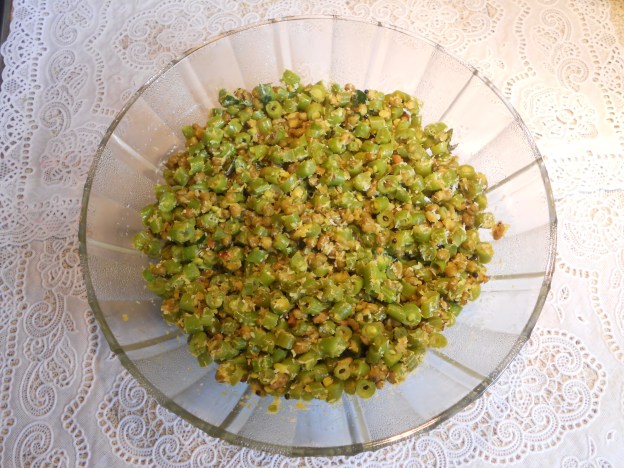
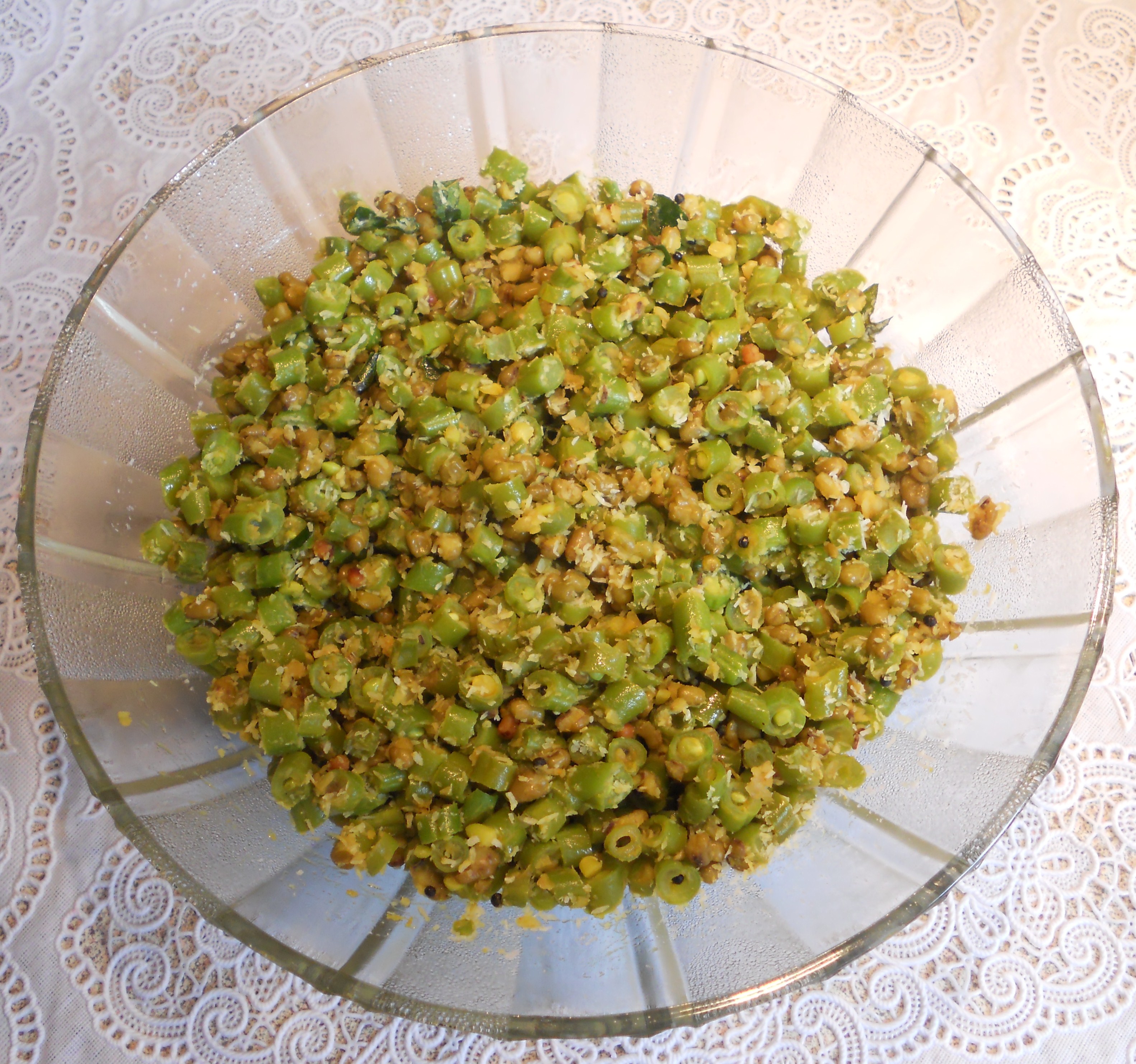
Beans Pachai payaru Thuvaran – Beans and Green gram dry curry

steamed beans

cooked green gram


thuvaran – dry curry


Ingredients

  • Green beans – 500 gms
  • Cooked green gram  – 1 cup
  • Oil – 1 tsp
  • Garlic – 3 cloves mashed coarsely
  • Green chillies – 2 no.s split into halves
  • Red chillies – 2 no.s broken into two  
  • Mustard seeds – 1/2 tsp
  • Urad dal – 1/2 tsp
  • Curry leaves – a few
  • Salt – to taste
  • Turmeric powder – 1/2 tsp
  • Asafoetida (Perungayam /Hing) – 1/2 tsp
  • Grated coconut – 1/2 cup (optional)

Method of preparation

  1. Finely cut green beans and steam in microwave for seven minutes
  2. If cooking in a pressure cooker, use water in the base of the cooker and cook beans without water in a smaller vessel inside
  3. Green gram should not be cooked mushy; it should be intact 
  4. Take one tsp cooking oil in a wide pan or kadai – (Iruppu Chatti)
  5. Add mustard seeds; when it splutters add urad dal
  6. Simmer and add curry leaves, crushed garlic and both the chillies
  7. Garlic is optional – It’s good as it reduces gastric problems which might arise due to the green gram
  8. Fry just for a few seconds since there is very little oil in the Chatti, it might get burnt easily
  9. Add the cooked beans and mix well
  10. Sprinkle turmeric powder and salt and mix
  11. Add the cooked green gram dal and mix all together
  12. Always keep the stove in minimum heat and close with lid for a couple of minutes
  13. Open the lid and stir for another minute and its done
  14. Sprinkle asafoetida on top and mix well (Asafoetida powder can also be added to oil initially if one dislikes the fresh sprinkled smell on top
  15. Also sprinkle freshly grated coconut
  16. Ready to serve with Rice and Kuzhambu/Chappathi and dal

Kaaikari Sodhi – Vegetable Stew (Maapillai Sodhi -The Son-in-law Stew)

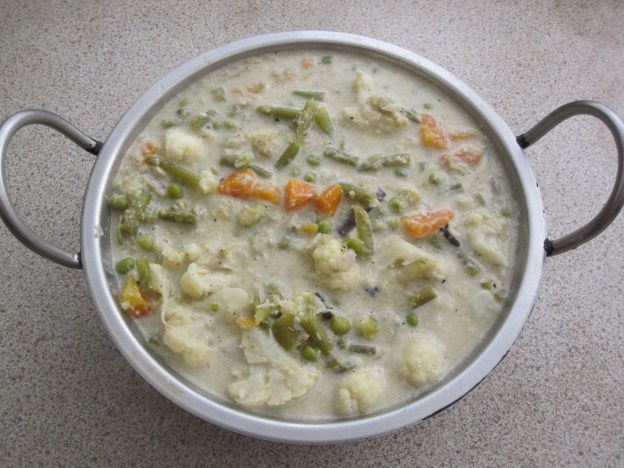
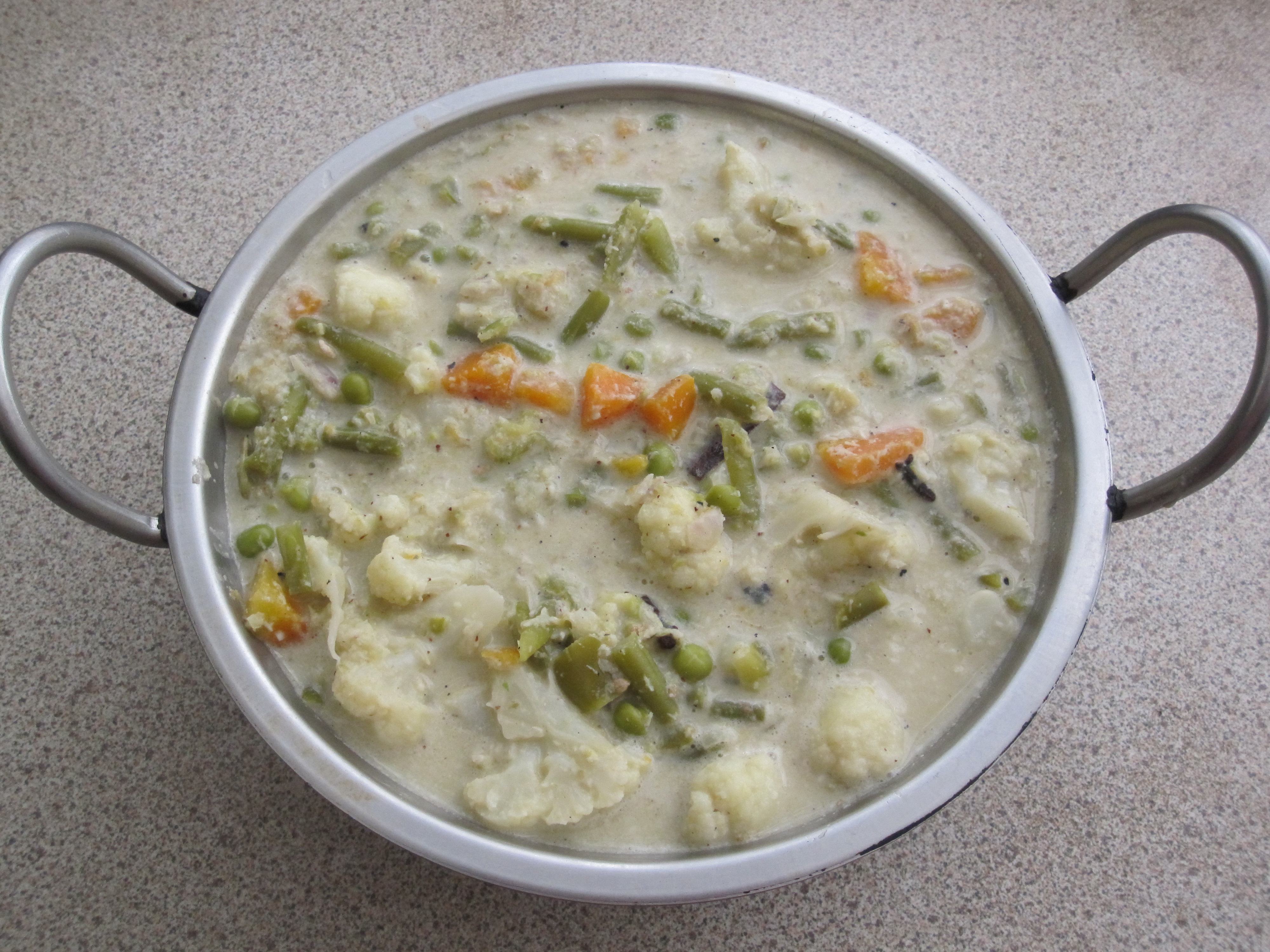
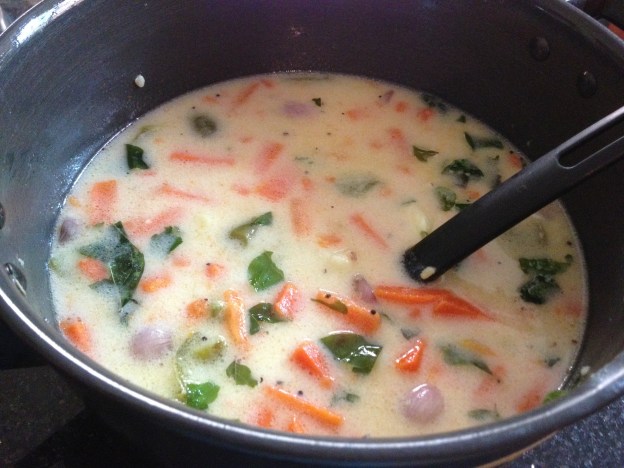
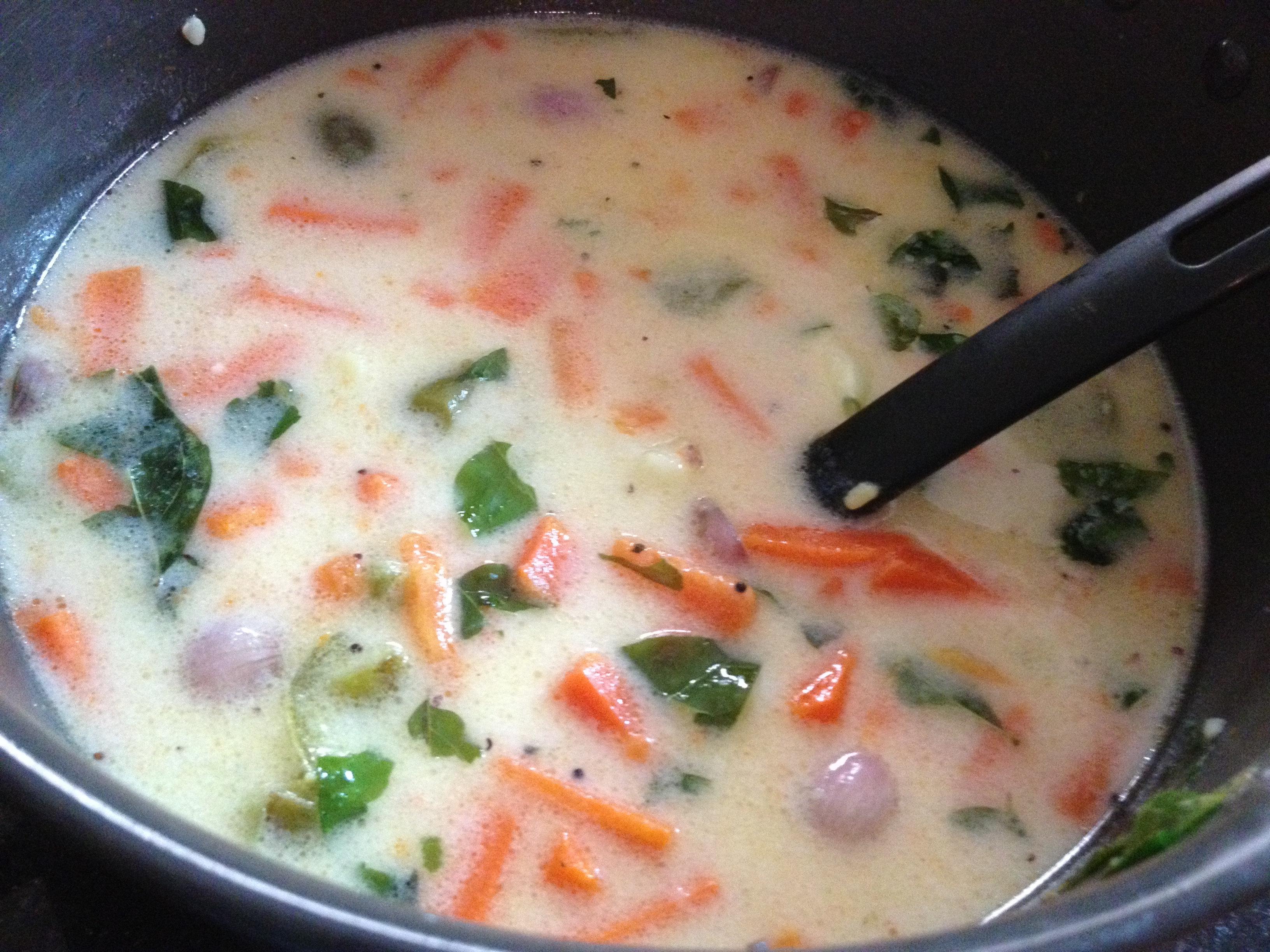
Kaaikari Sodhi – Vegetable Stew

In Tirunelveli and Thoothukudi – the down south districts of tamilnadu, kaaikari sodhi or vegetable stew is a special recipe. Speciality lies not only in its preparation but also in the occasion. The hindu marriage is held in the morning hours of the day. Evening is the reception with nalangu and simple games between bride and groom.  Next morning also has small and simple ceremonies with only close family members. Though the marriage is done by the bride’s family, this next day meal is hosted by the groom’s family which is Rice and Vegetable Stew.

From now on, the Stew travels hand in hand with the son-in-law. At least for the first few years, whenever the groom and bride visit relative’s places, they are always offered rice and vegetable stew with more delicacies.  As stew is cooked with coconut milk, for easy digestion it is always accompanied by ginger chutney.

Ingredients

  • carrots, beans, potatoes – cut into rectangular pieces – 1 cup
  • green peas – 1/4 cup
  • cauliflower – cut into small florets – 1/2 cup
  • small onions – 6 no.s
  • garlic – cut vertically – 6 cloves
  • cooked yellow lentil (peeled broken greengram – moong dal)  – 1/2 cup
  • cooking oil – 2 tsp.
  • salt – to taste

coconut milk: 

  • i. 1st milk – thick milk extracted  with less water – 1 cup
  • ii. 2nd milk – thinner than first with more water added while grinding – 1 cup
  • iii. 3rd milk – thinnest of all – 1 cup
  • coriander leaves – to garnish
  • lemon juice – 5 tsp

seasoning

  1. mustard seeds  – 1tsp
  2. curry leaves – a few
  3. green chillies – slit into halves – 3 no.s

Method of preparation

  1. Cook all the vegetables except cauliflower in the third milk until tender
  2. Blanch cauliflower separately
  3. Keep aside the cooked yellow lentil
  4. Heat oil in a heavy pan and add mustard seeds. let them splutter.
  5. Fry the onions, garlic cloves, green chillies and curry leaves. If small onions are not available, normal onions can be cut and used
  6. Add the cooked vegetables and the milk used for cooking and the cauliflower florets into the pan
  7. Add salt and bring it to boil
  8. Simmer and add the 2nd milk and stir
  9. Add the cooked lentil. Make it a little pulpy by adding some water. Or else lumps might be formed
  10. When this comes to a boil, add the thick 1st milk. Simmer for a while. Do not let it boil too much or else the coconut milk might curdle.
  11. Little water or thin coconut milk can be added for the right consistency
  12. Just before serving, add the lemon juice and mix well
  13. Garnish with coriander leaves and serve hot with rice

This stew is always had with Inji Thuvayal or Ginger Chutney. See inji thuvayal-ginger chutney for the recipe.

Tip: To make stew faster, vegetables can be steamed and thick 1st milk/canned coconut milk can be added instead of 1st, 2nd and 3rd milk. Though taste might differ a little, it is less time consuming.

Paasi paruppu Nei Urundai – Yellow Lentil Sweet Balls

Sorry for the long break. Just after I wrote the phrase – “peeping into grandma’s kitchen…”, I truly had an oppurtunity to peep into my granny’s kitchen. Yes.. I had been to India and literally had delicacies supervised and cooked by aachi herself and helped by amma.

NEI URUNDAI

We always start anything new with a sweet dish. So, here we go – ‘Nei Urundai’ translates as clarified butter balls. Nei is the tamil word for ghee or clarified butter and Urundai means ball. These are cute little balls that melt in your mouth and slide through your throat. Just be careful holding it or having the first bite. It breaks easily. So just handle it like a newly wed wife. Bet you wont stop with one – the sweet balls or the urundais I mean!

Ingredients

  • Skinless split green gram -yellow lentil (paasi paruppu/moong dal) – 1 cup -roast and ground finely (avoid granules)
  • ii. Sugar – 1 1/2 cups powdered
  • iii. Clarified butter (Nei) – 1/2 cup
    The quantity of the ingredients is before roast and ground.

Method of Preparation

  1. Take one cup split lentil, roast it in any pan and grind it fine. Usually it is done in bulk in any grinding mill in India. (It might not be as fine if done in a dry grinder at home – but its okay). Even after very fine grinding in a dry grinder if you find hard granules, you can sieve the powder.
  2. Powder the sugar and add both dry ingredients in a wide vessel.
  3. Heat the nei in a separate deep pan.
  4. The heating consistency of clarified butter is very important. When the clarified butter is really hot, take a teaspoon of it and pour it in the lentil-sugar mixture. There should be bubbles coming up. This is the right heat.
  5. Pour the total nei at one go and mix it randomly.
  6. Make medium sized balls when the mixture is really hot. This helps in binding the balls well.
    Its done and ready to taste!!

The above quantity would be sufficient to make 20 urundais.

A beginning

Vanakkam!

After a long long wait and research, I have started writing my blog. Before I start..

Thankyou so much Oz, for all the help. With kids and family, work and your blog,  preparing to shift to your own country and more, you have been guiding and pouring in suggestions, helping in the step by step process to start this blog, with the same gentleness and warmth always.

Thankyou Ganu and Meera, for all the thought provoking advices in detail.

Now.. About what I would like to share in ‘Dosaikal’… Is this a food blog with recipes and cooking ideas? Yes, food has always been one of my passions, even from those days when I didn’t know the differences in lentils! 

‘Dosaikal’ – when translated is  ‘The Pancake Pan’. Dosa is the  pancake and kal is the pan or tawa on which dosas are made. For me, it symbolises south indian cuisine..   The newest of the non-stick cookware can make better dosas or south indian pancakes – made of rice and dehusked blackgram batter. But, the best ones are made from the traditional cast iron tawas.  More so because, thick and fluffy grandma’s dosas, crispy crunchy amma’s dosas  or the ghee dosas my daughter demands – dosas make me travel on a different time machine, to my younger days of granny’s traditional recipes and life style.

Those are the moments I still cherish, the pleasant greeneries of down south districts of Tamilnadu, that sweet dialect of my mother tongue Tamil that makes me turn around immediately even today, the way we jump, run, dance, chat, fight, cry, giggle and laugh amidst cousins, aunts, uncles and above all grandma and grandpa – we call them aachi and thatha.

Somehow between the joys of togetherness, I can still smell the fragrances and flavours of mouth watering good food.. traditional tirunelveli and thoothukudi style. Thanks to amma and appa who gave me the strong base to absorb these fragrances and flavours of one’s own soil. So, why not add the flavours of traditional life style to modern day cooking!

 Now… Dosaikal is not about dosas alone.  The rich cultural heritage of the tamils goes hand in hand with the varieties of dishes cooked in households with the supervision of grandmother’s even today.. I would like to relive the past with those simple and exotic recipes. And nothing is best than sharing it with friends!

I can’t wait to get started!!